Sound quilts

A sound quilt (Overath et al., 2015) cuts a recording into segments of one length and strings them together in a new order, keeping the recording's structure inside each segment and scrambling everything longer than a segment.

  • How a quilt is made: the rule that picks the order, and the joining.
  • Quilting speech: two readers quilted at segment lengths from 30 to 960 ms, and how much the joins change the cochleagram.
  • Quilting a texture: fire and a stream quilted the same way, and what of the texture a quilt keeps.

Press play and a line follows the sound across every time axis in its plots. Click any time axis to play from that point. Start with your volume low.

To run this page yourself, open it as a notebook in Colab or download it. It is the same code, and it fetches the recordings it needs from the sonore repository.

Code the examples share

Every example below is the code shown with it, run after these cells: the level the gallery plays sounds at, and how a recording and its quilts are played together.

Setup, the same on every page
import os
import urllib.request

import matplotlib.pyplot as plt
import numpy as np

import sonore as so

plt.rcParams.update({"font.size": 9, "axes.titlesize": 10, "figure.dpi": 100})


def fetch(path):
    """A file from the sonore repository, by its path there: the local copy when this runs from
    the repository root, otherwise downloaded from GitHub to the same relative path."""
    if not os.path.exists(path):
        os.makedirs(os.path.dirname(path) or ".", exist_ok=True)
        urllib.request.urlretrieve("https://raw.githubusercontent.com/choyun1/sonore/main/" + path, path)
    return path


def finish(snd):
    """How every sound in the gallery is played: 5 ms ramps, RMS 0.1, peak at most 0.95."""
    snd = snd.ramp(5e-3).normalize(rms=0.1)
    return snd.normalize(peak=0.95) if snd.peak > 0.95 else snd
Code
def finish_together(sounds):
    """How a recording and its quilts are played: 5 ms ramps, and one gain for all of them, the
    largest that keeps every RMS at most 0.1 and every peak at most 0.95. A quilt keeps the level
    of its recording, and one gain keeps that visible; scaling each sound on its own would let a
    single loud event in one of them turn that one down."""
    ramped = {label: snd.ramp(5e-3) for label, snd in sounds.items()}
    gain = min(min(0.1 / snd.rms, 0.95 / snd.peak) for snd in ramped.values())
    return {label: so.Sound(snd.data * gain, snd.fs) for label, snd in ramped.items()}

How a quilt is made

Each next segment is the one whose join with the current segment changes the cochleagram by about as much as the recording itself changed at that point, and a join the recording already had is never used. Overath et al. quilted German speech for listeners who knew no German, at segment lengths from 30 to 960 ms, and found a region of the superior temporal sulcus whose response grew with segment length up to about 500 ms. so.quilt follows the paper's methods; so.splice is its joining step, which moves each segment by up to 15 ms so that its waveform lines up with what came before, then cross-fades over 30 ms. A quilt keeps the level of its recording, so each recording and its quilts below are played at one gain.

Quilting speech

The passages here are about 30 s of English read speech from LibriSpeech (Panayotov et al., 2015). For a listener who knows English, words in the long-segment quilts carry meaning, which the paper avoided by using a language its listeners did not know. As in the paper, pauses are removed first. Without that, short-segment quilts string silences together: one silent segment changes little into another, and little is what the passage itself changes across a silence (a first build of this page gave a 6 s quilt of 30 ms segments with 4 s of silence). The cut uses the thresholds of McDermott's toolbox, and so.splice does the cutting: the kept 30 ms windows, joined with 10 ms cross-fades and no shifts, give back the passage exactly except at the cuts. The paper also band-limited its sources and faded out each quilt; that is not done here.

Code
# A male and a female LibriSpeech reader (docs/speech/SOURCES.md), at 16 kHz.
READERS = {"Male reader": "3000_15664", "Female reader": "1462_170142"}


def without_pauses(snd, window=0.03, below_db=35, min_windows=8):
    """``snd`` with every run of at least ``min_windows`` windows more than ``below_db`` below the
    loudest window cut out, the rest joined by ``so.splice`` with 10 ms cross-fades."""
    n = int(round(window * snd.fs))
    frames = snd.data[: len(snd) // n * n, 0].reshape(-1, n)
    level = 10 * np.log10(np.mean(frames**2, axis=1) + 1e-20)  # dB per window
    quiet = np.concatenate([[False], level < level.max() - below_db, [False]])
    edges = np.flatnonzero(np.diff(quiet.astype(int)))  # starts and ends of quiet runs
    keep = np.ones(len(frames), dtype=bool)
    for start, end in zip(edges[::2], edges[1::2], strict=True):
        if end - start >= min_windows:
            keep[start:end] = False
    return so.splice(snd, np.flatnonzero(keep) * n / snd.fs, n / snd.fs, crossfade=0.01, max_shift=0)


passages = {
    label: without_pauses(so.load(fetch(f"docs/speech/librispeech_{reader}.flac")))
    for label, reader in READERS.items()
}
for label, passage in passages.items():
    print(f"{label}: {passage.duration:.1f} s without pauses")
SEGMENTS = [0.03, 0.12, 0.48, 0.96]  # s
QUILT_DUR = 6.0  # s
quilt_bank = so.cosine_filterbank(30, 20, 8000)  # the paper's bank, up to Nyquist at 16 kHz


def quilt_demo(passage):
    """The passage's first 6 s and a 6 s quilt at each segment length, with their cochleagrams
    on one color scale."""
    sounds = {"Original": so.Sound(passage.data[: int(QUILT_DUR * passage.fs)], passage.fs)}
    for seg in SEGMENTS:
        sounds[f"{seg * 1000:.0f} ms"] = so.quilt(passage, seg, QUILT_DUR, rng=1)
    sounds = finish_together(sounds)
    fig, axes = plt.subplots(len(sounds), 1, figsize=(7, 5), sharex=True, layout="constrained")
    envelopes = {label: quilt_bank.analyze(snd).envelopes() for label, snd in sounds.items()}
    top = envelopes["Original"].db[:, 1:-1].max()  # all on the original's color scale
    for ax, (label, env) in zip(axes, envelopes.items(), strict=True):
        env.plot(ax, colorbar=False, db_max=top)
        title = label if label == "Original" else f"Quilt, {label} segments"
        ax.set(title=title, xlabel="", ylabel="", xlim=(0, QUILT_DUR))
    axes[-1].set_xlabel("Time [s]")
    fig.supylabel("Frequency [Hz]", fontsize=9)
    return fig, sounds, {label: [ax] for label, ax in zip(sounds, axes, strict=True)}
Male reader: 24.6 s without pauses
Female reader: 23.8 s without pauses

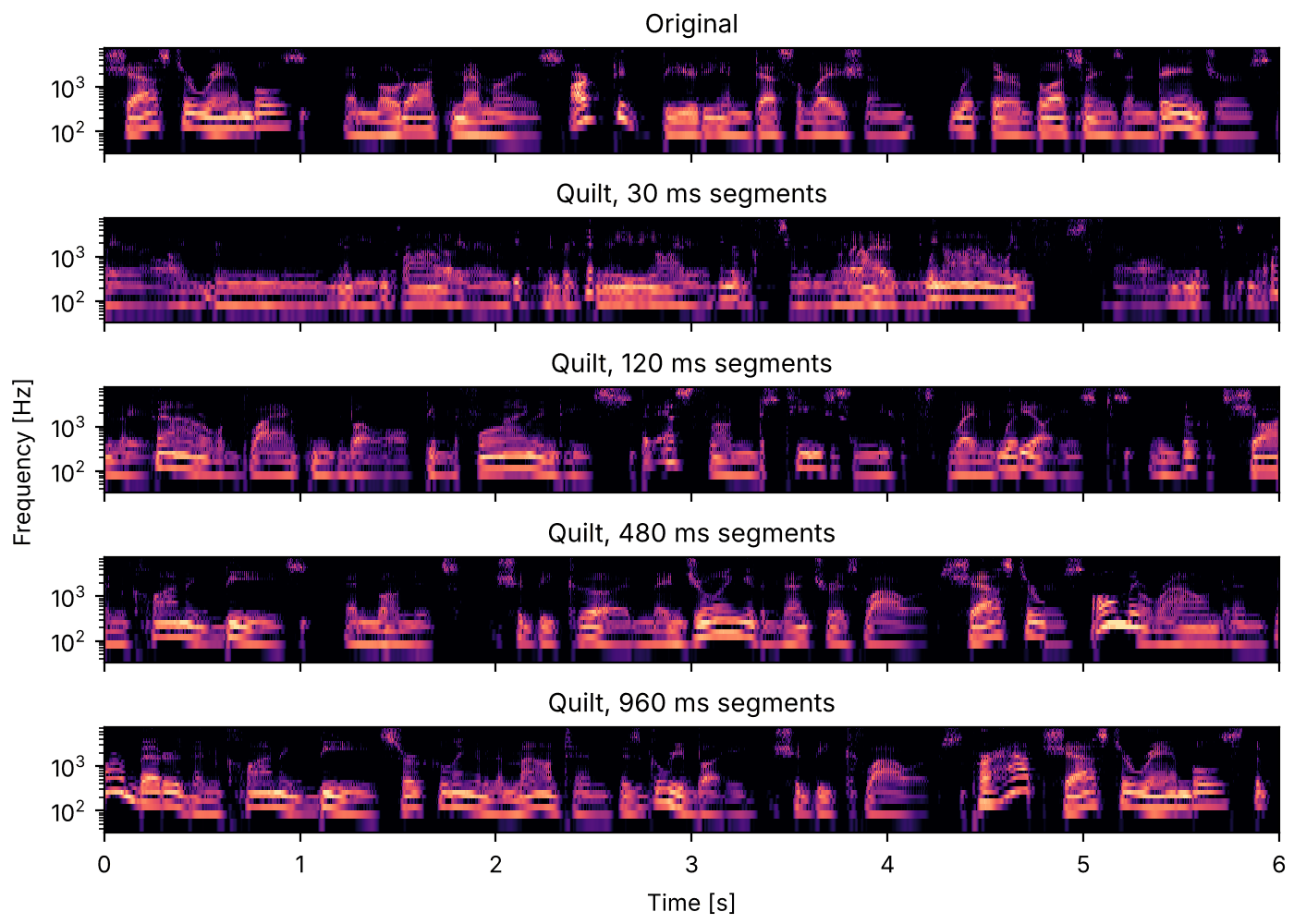
Quilts of a male reader

The first 6 s of the passage without its pauses, then quilts of the whole passage made of 30, 120, 480 and 960 ms segments. A 30 ms segment is shorter than most speech sounds, a 120 ms one about a syllable, and a 960 ms one a few words. At 30 ms the rule tends to chain segments with similar spectra, and the cochleagram shows long, steady stretches that the passage does not have.

Original

sq1_quilts_of_a_male_reader_original.flac, 6.0 s, mono

30 ms

sq1_quilts_of_a_male_reader_30_ms.flac, 6.0 s, mono

120 ms

sq1_quilts_of_a_male_reader_120_ms.flac, 6.0 s, mono

480 ms

sq1_quilts_of_a_male_reader_480_ms.flac, 6.0 s, mono

960 ms

sq1_quilts_of_a_male_reader_960_ms.flac, 6.0 s, mono

Plots of the quilts of a male reader sounds
Code
fig, sounds, playhead = quilt_demo(passages["Male reader"])

Quilts of a female reader

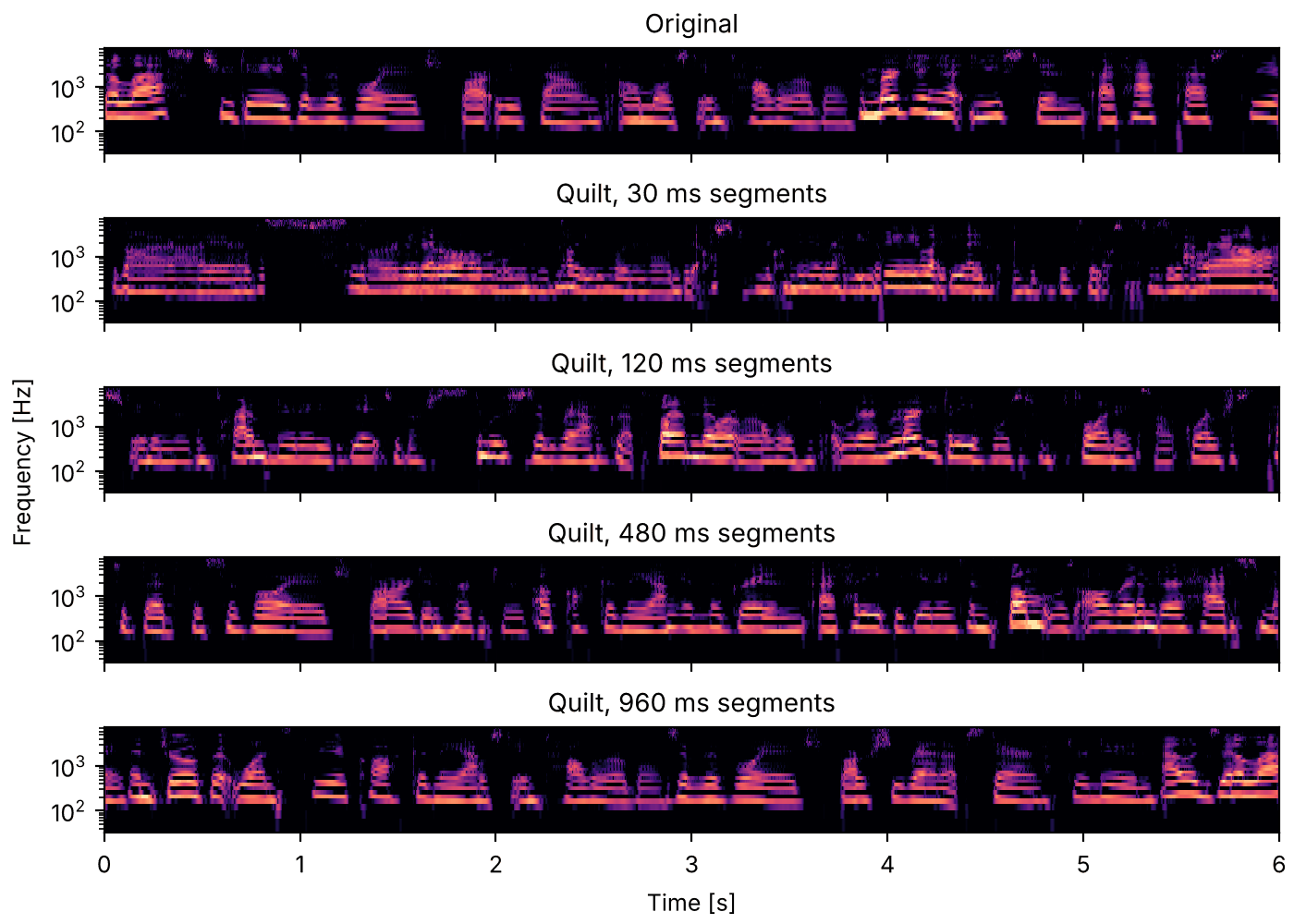
The same for the female reader.

Original

sq2_quilts_of_a_female_reader_original.flac, 6.0 s, mono

30 ms

sq2_quilts_of_a_female_reader_30_ms.flac, 6.0 s, mono

120 ms

sq2_quilts_of_a_female_reader_120_ms.flac, 6.0 s, mono

480 ms

sq2_quilts_of_a_female_reader_480_ms.flac, 6.0 s, mono

960 ms

sq2_quilts_of_a_female_reader_960_ms.flac, 6.0 s, mono

Plots of the quilts of a female reader sounds
Code
fig, sounds, playhead = quilt_demo(passages["Female reader"])

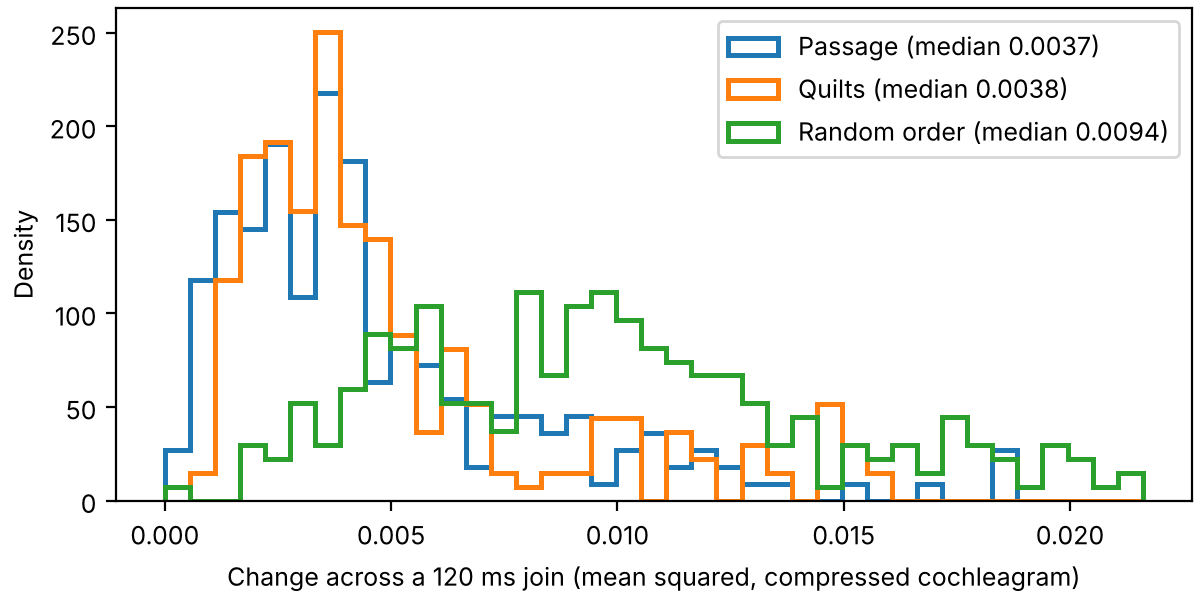
The rule that picks the order is what keeps the joins from standing out. The change across a join is measured as the paper does: the mean squared difference between the last 30 ms before it and the first 30 ms after it, in the cochleagram compressed by the power 0.3. Every join of a quilt falls at a whole number of segments, since the alignment moves where a segment is read from, not where it is written, so the changes can be measured on the quilt itself.

Change across the joins

The changes across 120 ms joins: between neighboring segments of the male reader's passage, at the joins of 30 s of quilts made from it, and at the joins of 30 s of the same segments put in a random order with so.splice. The quilts' joins change about as much as the passage's own boundaries (medians in the legend); the random joins change between two and three times as much.

Change across the joins
Code
def join_changes(snd, segment, border=0.03):
    """The cochleagram change across every boundary at a multiple of ``segment`` [s]."""
    n, nb = int(round(segment * snd.fs)), int(round(border * snd.fs))
    env = quilt_bank.analyze(snd).envelopes().data[:, :, 0] ** 0.3
    joins = np.arange(n, len(env) - nb + 1, n)
    return np.array([np.mean((env[j - nb : j] - env[j : j + nb]) ** 2) for j in joins])


passage, seg = passages["Male reader"], 0.12
n_segments = len(passage) // int(seg * passage.fs)
rng = np.random.default_rng(0)
quilts = [so.quilt(passage, seg, QUILT_DUR, rng=k) for k in range(5)]
shuffled = [so.splice(passage, rng.permutation(n_segments)[:50] * seg, seg) for _ in range(5)]
changes = {
    "Passage": join_changes(passage, seg),
    "Quilts": np.concatenate([join_changes(q, seg) for q in quilts]),
    "Random order": np.concatenate([join_changes(s, seg) for s in shuffled]),
}
fig, ax = plt.subplots(figsize=(6, 3), layout="constrained")
bins = np.linspace(0, np.percentile(np.concatenate(list(changes.values())), 99), 40)
for label, values in changes.items():
    legend = f"{label} (median {np.median(values):.4f})"
    ax.hist(values, bins, density=True, histtype="step", lw=1.8, label=legend)
ax.set(xlabel="Change across a 120 ms join (mean squared, compressed cochleagram)", ylabel="Density")
ax.legend()

Quilting a texture

A texture, such as fire or a stream, has little structure longer than a few hundred milliseconds, so a quilt of one should sound like more of the same texture even with short segments, as McDermott's notes to the quilting toolbox observe. The texture model of Sound textures (McDermott & Simoncelli, 2011) summarizes a texture by a few time-averaged statistics of its cochlear envelopes, and the last figure uses three of them to check this.

Code
texture_bank = so.cosine_filterbank(30, 20, 10000)


def texture_quilt_demo(recording, duration, segments=(0.03, 0.12, 0.96)):
    """The recording's first ``duration`` seconds and a quilt of the whole recording at each
    segment length, played at one gain, with their cochleagrams on one color scale."""
    sounds = {"Original": so.Sound(recording.data[: int(duration * recording.fs)], recording.fs)}
    for seg in segments:
        sounds[f"{seg * 1000:.0f} ms"] = so.quilt(recording, seg, duration, rng=1)
    sounds = finish_together(sounds)
    fig, axes = plt.subplots(len(sounds), 1, figsize=(7, 4), sharex=True, layout="constrained")
    envelopes = {label: texture_bank.analyze(snd).envelopes() for label, snd in sounds.items()}
    top = envelopes["Original"].db[:, 1:-1].max()  # all on the original's color scale
    for ax, (label, env) in zip(axes, envelopes.items(), strict=True):
        env.plot(ax, colorbar=False, db_max=top)
        title = label if label == "Original" else f"Quilt, {label} segments"
        ax.set(title=title, xlabel="", ylabel="", xlim=(0, duration))
    axes[-1].set_xlabel("Time [s]")
    fig.supylabel("Frequency [Hz]", fontsize=9)
    return fig, sounds, {label: [ax] for label, ax in zip(sounds, axes, strict=True)}

Quilts of a fire

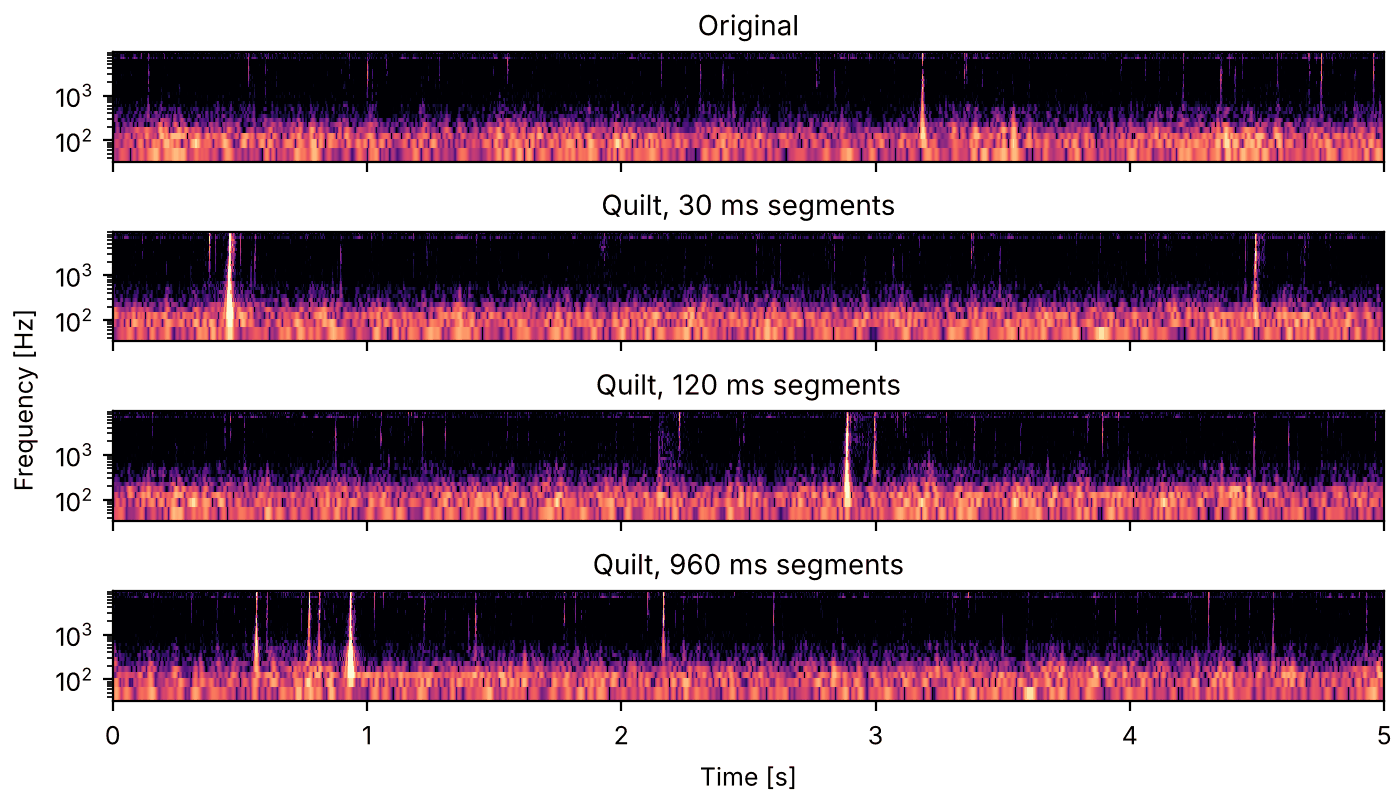
The first 5 s of a 20 s recording of fire, then 5 s quilts of the whole recording made of 30, 120 and 960 ms segments. The recording has one crackle, at 10 s, that peaks about five times higher than anything in its first 5 s. Each quilt here draws that crackle or another large pop from the rest of the recording, and the loudest of them sets the one gain all four are played at, so the quilts' quieter stretches play at the same level as the original's.

Original

sq4_quilts_of_a_fire_original.flac, 5.0 s, mono

30 ms

sq4_quilts_of_a_fire_30_ms.flac, 5.0 s, mono

120 ms

sq4_quilts_of_a_fire_120_ms.flac, 5.0 s, mono

960 ms

sq4_quilts_of_a_fire_960_ms.flac, 5.0 s, mono

Plots of the quilts of a fire sounds
Code
fig, sounds, playhead = texture_quilt_demo(so.load(fetch("docs/textures/fire.flac")), 5.0)

Quilts of a stream

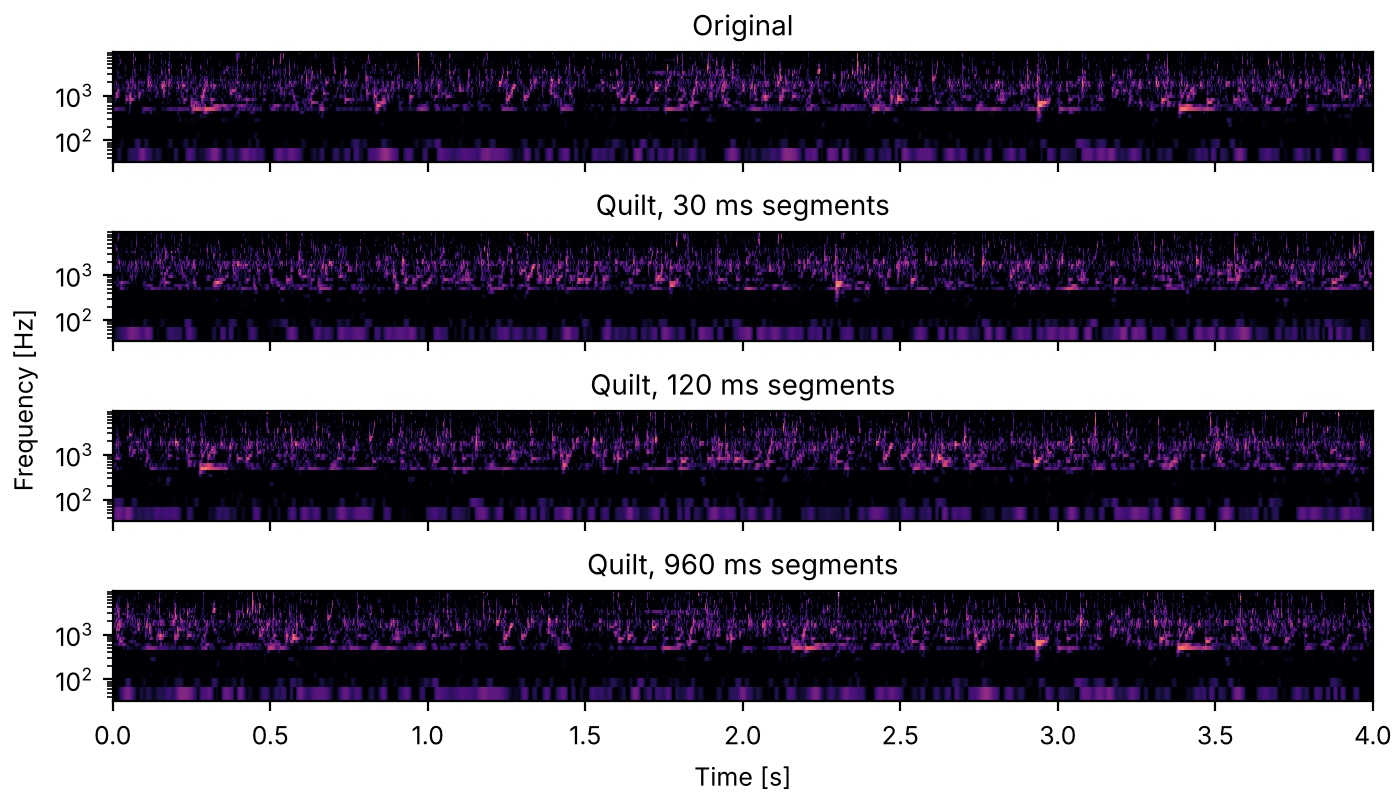
The same for 7 s of a stream (the recording on Sound textures), with 4 s quilts. The recording is short: a quilt of 960 ms segments uses 5 of its 7 segments, so the rule has few to choose from, and a quilt of 30 ms segments uses 134 of 233. With 30 ms cross-fades on 30 ms segments every sample lies in a cross-fade, and the paper's raised-cosine ramps keep only 3/4 of the power of two unrelated stretches of noise, so its 30 ms quilts of a stream play about 1 dB quieter. so.quilt scales each cross-fade by the correlation it measures between the two segments (fade="adaptive", the default), which keeps the level.

Original

sq6_quilts_of_a_stream_original.flac, 4.0 s, mono

30 ms

sq6_quilts_of_a_stream_30_ms.flac, 4.0 s, mono

120 ms

sq6_quilts_of_a_stream_120_ms.flac, 4.0 s, mono

960 ms

sq6_quilts_of_a_stream_960_ms.flac, 4.0 s, mono

Plots of the quilts of a stream sounds
Code
fig, sounds, playhead = texture_quilt_demo(so.load(fetch("docs/textures/stream.flac")), 4.0)

What a texture quilt keeps

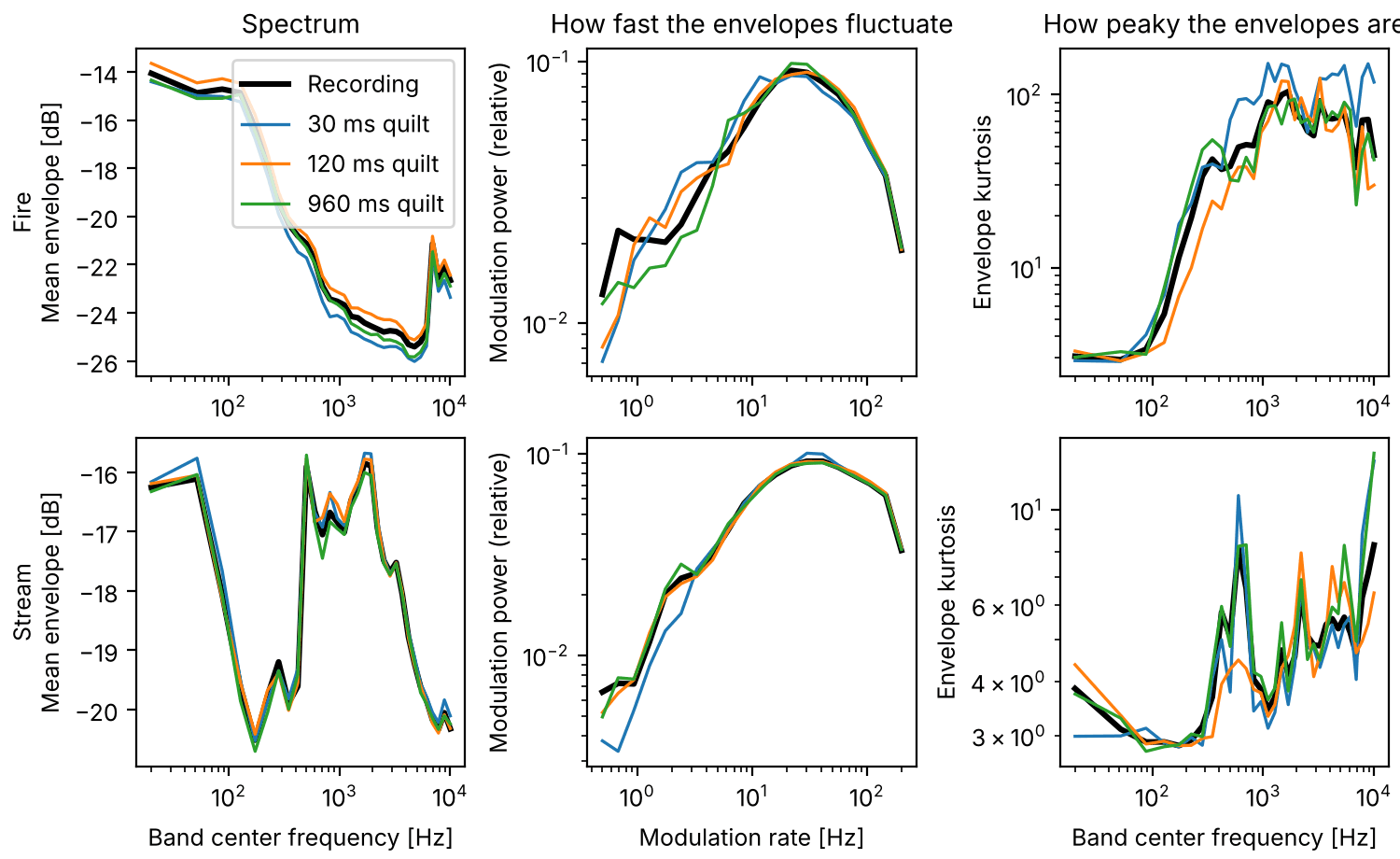
Three of the statistics the texture model of Sound textures measures, for the whole recording (black) and for each quilt heard above (colors), with the level set aside. Left, the spectrum: the mean envelope of each cochlear band. Middle, how strongly the envelopes fluctuate at each rate from 0.5 to 200 Hz, averaged over the bands. Right, how peaky each band's envelope is (its kurtosis): high where the sound comes in brief pops, like fire's crackle above about 150 Hz, and about 3 for steady noise. The quilts follow the recording closely in all three, which is what "more of the same texture" means here. They part most at the slowest fluctuations, below a few hertz, where fire's quilts have less power than the recording, and in fire's peakiness, which depends on which pops a quilt happens to draw.

What a texture quilt keeps
Code
from sonore.texture import TextureModel, TextureStats

model = TextureModel()
band_cfs, rate_cfs = model.filterbank.cfs, model.mod_bank.cfs
fig, axes = plt.subplots(2, 3, figsize=(7.5, 4.6), layout="constrained")
for row, (name, duration) in enumerate((("fire", 5.0), ("stream", 4.0))):
    recording = so.load(fetch(f"docs/textures/{name}.flac"))
    stats = {"Recording": TextureStats.measure(recording)}
    for seg in (0.03, 0.12, 0.96):  # the quilts heard above: same seed
        stats[f"{seg * 1000:.0f} ms quilt"] = TextureStats.measure(so.quilt(recording, seg, duration, rng=1))
    for label, st in stats.items():
        style = {"color": "k", "lw": 2.2} if label == "Recording" else {"lw": 1.2}
        audible = st.channel_mask()  # bands within 30 dB of the loudest
        axes[row, 0].plot(band_cfs, 20 * np.log10(st.env_mean), label=label, **style)
        axes[row, 1].plot(rate_cfs, np.mean(st.mod_power[audible], axis=0), **style)
        axes[row, 2].plot(band_cfs, st.env_kurt, **style)
    axes[row, 0].set(xscale="log", ylabel=f"{name.capitalize()}\nMean envelope [dB]")
    axes[row, 1].set(xscale="log", yscale="log", ylabel="Modulation power (relative)")
    axes[row, 2].set(xscale="log", yscale="log", ylabel="Envelope kurtosis")
axes[0, 0].set_title("Spectrum")
axes[0, 1].set_title("How fast the envelopes fluctuate")
axes[0, 2].set_title("How peaky the envelopes are")
for ax in axes[1]:
    ax.set_xlabel("Modulation rate [Hz]" if ax is axes[1, 1] else "Band center frequency [Hz]")
axes[0, 0].legend()

References

  • McDermott & Simoncelli (2011). Sound texture perception via statistics of the auditory periphery: evidence from sound synthesis. Neuron 71(5), 926–940. doi:10.1016/j.neuron.2011.06.032. texture
  • Overath, McDermott, Zarate & Poeppel (2015). The cortical analysis of speech-specific temporal structure revealed by responses to sound quilts. Nature Neuroscience 18, 903–911. doi:10.1038/nn.4021. quilting.quilt processing.splice
  • Panayotov, Chen, Povey & Khudanpur (2015). LibriSpeech: an ASR corpus based on public domain audio books. Proc. ICASSP 2015, 5206–5210. doi:10.1109/ICASSP.2015.7178964. The two quilted passages (CC BY 4.0; sources in docs/speech/SOURCES.md).