Code
# Each scene's cast: LibriSpeech reader and chapter, label in the plots, color. A reader in two
# casts reads from a different chapter.
PAIR = [("2035_152373", "female talker", "#d62728"), ("5694_64029", "male talker", "#1f77b4")]
TRIO = [
    ("6345_93306", "female talker", "#d62728"),
    ("251_136532", "male talker A", "#1f77b4"),
    ("2428_83705", "male talker B", "#2ca02c"),
]
FOURSOME = [
    ("1462_170142", "female talker A", "#d62728"),
    ("3000_15664", "male talker A", "#1f77b4"),
    ("1993_147149", "female talker B", "#ff7f0e"),
    ("1272_141231", "male talker B", "#2ca02c"),
]
SIXSOME = [
    ("5338_284437", "female talker A", "#d62728"),
    ("8297_275155", "male talker A", "#1f77b4"),
    ("8842_304647", "female talker B", "#ff7f0e"),
    ("5694_64025", "male talker B", "#2ca02c"),
    ("2035_147961", "female talker C", "#9467bd"),
    ("2428_83699", "male talker C", "#8c564b"),
]
ROOM_HALF_WIDTH = 8.0  # m: the room is 16 m by 16 m, with the listener in the middle
PERSONAL_SPACE = 1.5  # m: no talker comes nearer the listener than this
PATH_STEP = 0.05  # s between points on a path


def walks(n_talkers, duration, seed):
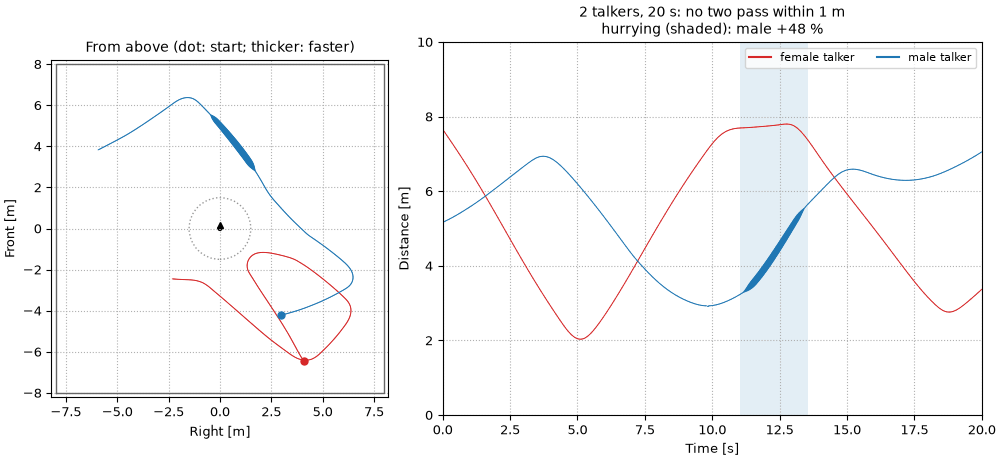
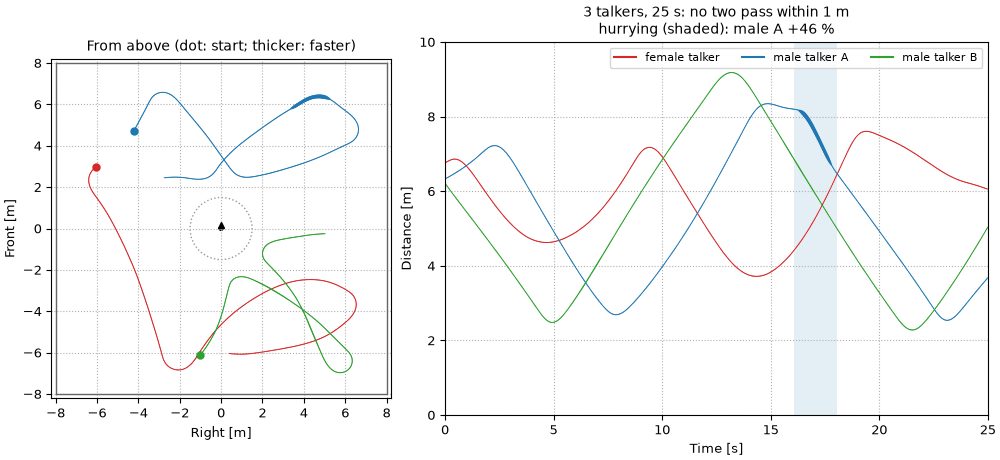
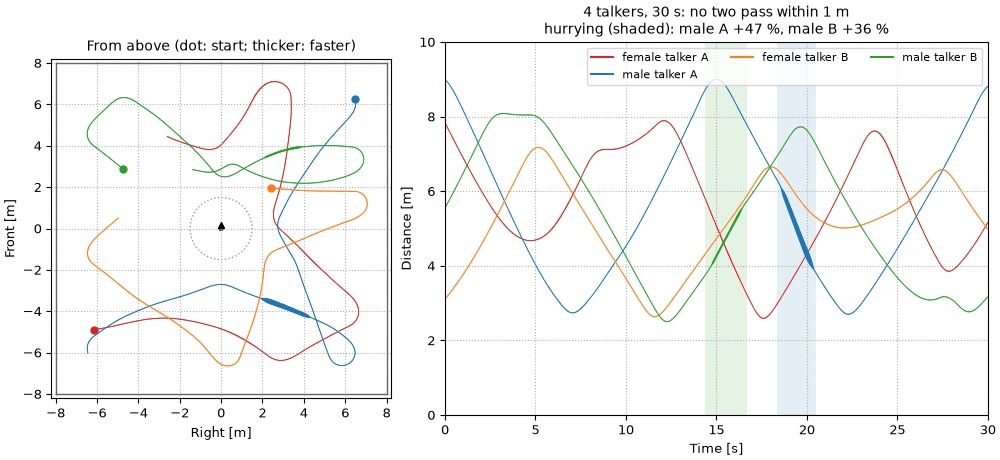
    """One walk across the room per talker: a list of (times [s], points [m], shape (n, 3)).
    Each talker walks straight ahead, but its heading drifts slowly (a few degrees per second,
    changing over about 3 s), and it bends away from what is near: a wall within 2 m, the
    listener within 3 m (and never nearer than 1.5 m), another talker within 1.5 m (stepping to
    the right to pass), harder the closer it gets, turning at most 90 degrees per second. Its
    speed drifts by up to 10 % around its own, and it slows down when another
    talker is close ahead, easing into the new pace over about 0.3 s rather than braking at once.
    Half the talkers (at least one) also hurry once, for 2 to 3 s, 25 to 50 % faster, easing
    in and out over 0.5 s. Returns the walks and the hurries as (talker, start [s], length
    [s], speed-up)."""
    rng = np.random.default_rng(seed)
    times = np.arange(0, duration + PATH_STEP, PATH_STEP)
    own_speed = rng.uniform(0.9, 1.3, n_talkers)
    period, phase = rng.uniform(5, 10, n_talkers), rng.uniform(0, 2 * np.pi, n_talkers)
    speed = own_speed * (1 + 0.1 * np.sin(2 * np.pi * times[:, None] / period + phase))  # (times, talkers)
    hurries = []
    for talker in rng.choice(n_talkers, size=max(1, n_talkers // 2), replace=False):
        start, length, speed_up = rng.uniform(3, duration - 6), rng.uniform(2, 3), rng.uniform(1.25, 1.5)
        ease = np.clip(np.minimum(times - start, start + length - times) / 0.5, 0, 1)
        speed[:, talker] *= 1 + (speed_up - 1) * np.sin(np.pi / 2 * ease) ** 2
        hurries.append((int(talker), start, length, speed_up))
    starts = []
    while len(starts) < n_talkers:  # apart, at least 1.5 m from the walls and 3 m from the listener
        candidate = rng.uniform(-ROOM_HALF_WIDTH + 1.5, ROOM_HALF_WIDTH - 1.5, 2)
        clear = all(np.linalg.norm(candidate - other) > 1.5 for other in starts)
        if np.linalg.norm(candidate) > PERSONAL_SPACE + 1.5 and clear:
            starts.append(candidate)
    position = np.array(starts)  # (talkers, 2)
    heading = rng.uniform(-np.pi, np.pi, n_talkers)  # direction of travel, angle from +x
    wobble = np.zeros(n_talkers)  # rad/s
    pace = np.ones(n_talkers)  # the slowing, eased
    others = 1 - np.eye(n_talkers)
    points = np.zeros((n_talkers, len(times), 3))
    for step in range(len(times)):
        points[:, step, :2] = position
        facing = np.column_stack([np.cos(heading), np.sin(heading)])
        wanted = facing.copy()
        gap = ROOM_HALF_WIDTH - np.abs(position)  # to the nearer wall along each axis
        wanted -= 4.0 * np.sign(position) * np.clip(1 - gap / 2.0, 0, None)
        distance = np.linalg.norm(position, axis=1, keepdims=True)
        wanted += 3.0 * position / distance * np.clip(1 - (distance - PERSONAL_SPACE) / 1.5, 0, None)
        between = position[:, None] - position[None, :]  # (talker, other, xy): from the other to the talker
        apart = np.linalg.norm(between, axis=2) + np.eye(n_talkers)
        push = (np.clip(1 - apart / 1.5, 0, None) * others)[:, :, None] * between / apart[:, :, None]
        away = push.sum(axis=1)
        wanted += 3.0 * (away + 0.7 * np.column_stack([away[:, 1], -away[:, 0]]))  # keep to the right
        # others within 60 degrees of straight ahead
        ahead = (np.einsum("tox,tx->to", -between, facing) > 0.5 * apart) & (others > 0)
        nearest_ahead = np.where(ahead, apart, np.inf).min(axis=1)
        slowing = np.clip((nearest_ahead - 0.5) / 1.0, 0.15, 1.0)
        pace += (slowing - pace) * PATH_STEP / 0.3
        wobble += -wobble * PATH_STEP / 3.0 + np.radians(4) * np.sqrt(PATH_STEP) * rng.normal(size=n_talkers)
        off_course = np.angle(np.exp(1j * (np.arctan2(wanted[:, 1], wanted[:, 0]) - heading)))
        heading += (np.clip(2.0 * off_course, -np.radians(90), np.radians(90)) + wobble) * PATH_STEP
        step_length = speed[step] * pace * PATH_STEP
        position = position + step_length[:, None] * np.column_stack([np.cos(heading), np.sin(heading)])
        distance = np.linalg.norm(position, axis=1, keepdims=True)  # step back out of the listener's space
        position = np.where(distance < PERSONAL_SPACE, position * PERSONAL_SPACE / distance, position)
        position = np.clip(position, -ROOM_HALF_WIDTH, ROOM_HALF_WIDTH)
    return [(times, talker_points) for talker_points in points], hurries


PARTY_ROOM = so.synth_ir(0.3, fs, n_channels=2, rng=2)  # RT60 0.3 s
PARTY_DRR = 15.0  # dB at 1 m: direct and reverberant sound are equal 5.6 m away
PARTY_FADE = 2.0  # s, at the start and end of each scene


def party(cast, duration, seed, room=PARTY_ROOM):
    """The cast's voices, each from the start of its passage for ``duration`` [s], each on its
    own walk. Returns the mix, each talker's path and the hurries."""
    voices = so.normalize([so.load(fetch(f"docs/speech/librispeech_{reader}.flac")) for reader, _, _ in cast])
    paths, hurries = walks(len(cast), duration, seed)
    rendered = []
    for voice, (times, points) in zip(voices, paths, strict=False):
        excerpt = so.Sound(voice.data[: int(duration * fs)], fs).ramp(20e-3)
        rendered.append(so.move_sound(excerpt, (times, points), hrirs, room=room, drr_db=PARTY_DRR))
    return so.mix(rendered).ramp(PARTY_FADE), paths, hurries


def close_passes(paths, within=1.0):
    """The pairs of talkers that, at some moment, are less than ``within`` [m] apart."""
    pairs = []
    for first in range(len(paths)):
        for second in range(first + 1, len(paths)):
            apart = np.linalg.norm(paths[first][1] - paths[second][1], axis=1)
            if apart.min() < within:
                pairs.append((first, second, float(apart.min())))
    return pairs


def passes_title(cast, duration, paths, hurries):
    pairs = close_passes(paths)
    if pairs:
        closest = min(apart for _, _, apart in pairs)
        passing = f"{len(pairs)} {'pair passes' if len(pairs) == 1 else 'pairs pass'} within 1 m"
        passing += f" (closest {closest:.1f} m)"
    else:
        passing = "no two pass within 1 m"
    hurrying = ", ".join(
        f"{cast[talker][1].replace(' talker', '')} +{100 * (speed_up - 1):.0f} %"
        for talker, _, _, speed_up in hurries
    )
    return f"{len(cast)} talkers, {duration:.0f} s: {passing}\nhurrying (shaded): {hurrying}"


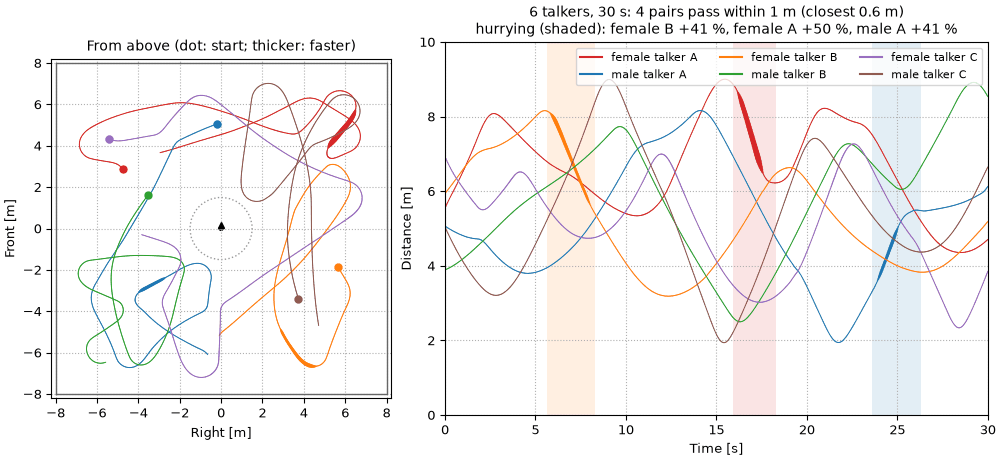
def show_party(cast, paths, hurries, title):
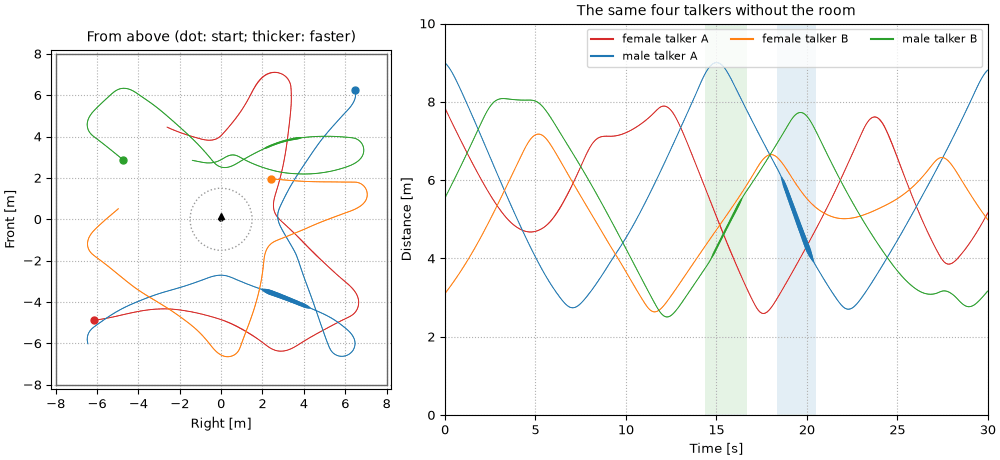
    """The paths from above (a dot where each talker starts, thick where it hurries), and each
    talker's distance (shaded where it hurries). Both lines thicken with the talker's speed
    above its usual pace, so a hurry shows as a line that swells and thins again."""
    fig = plt.figure(figsize=(10, 4.6), layout="constrained")
    top, distance_axes = fig.subplots(1, 2, width_ratios=(1, 1.6))
    for (times, points), (_, label, color) in zip(paths, cast, strict=False):
        speed = np.linalg.norm(np.diff(points, axis=0), axis=1) / np.diff(times)
        above_usual = np.clip(speed / np.median(speed) - 1.1, 0, None)  # the drift stays within 10 %
        widths = 0.7 + 8 * above_usual
        distance = np.linalg.norm(points, axis=1)
        for x, y, ax in ((points[:, 0], points[:, 1], top), (times, distance, distance_axes)):
            segments = np.stack([np.column_stack([x[:-1], y[:-1]]), np.column_stack([x[1:], y[1:]])], 1)
            ax.add_collection(LineCollection(segments, linewidths=widths, color=color, capstyle="round"))
        top.plot(*points[0, :2], "o", color=color, ms=5)
        distance_axes.plot([], [], color=color, lw=1.5, label=label)
    for talker, start, length, _ in hurries:
        distance_axes.axvspan(start, start + length, color=cast[talker][2], alpha=0.12, lw=0)
    top.add_patch(plt.Circle((0, 0), 0.09, fill=False, color="k"))
    top.plot([0], [0.16], "^", color="k", ms=4)  # the listener faces +y
    top.add_patch(plt.Circle((0, 0), PERSONAL_SPACE, fill=False, color="0.6", ls=":"))
    edge = ROOM_HALF_WIDTH
    top.plot([-edge, edge, edge, -edge, -edge], [-edge, -edge, edge, edge, -edge], color="0.4", lw=1)
    top.set(
        xlim=(-edge - 0.2, edge + 0.2),
        ylim=(-edge - 0.2, edge + 0.2),
        aspect="equal",
        xlabel="Right [m]",
        ylabel="Front [m]",
        title="From above (dot: start; thicker: faster)",
    )
    distance_axes.set(
        ylim=(0, 12), xlim=(0, paths[0][0][-1]), xlabel="Time [s]", ylabel="Distance [m]", title=title
    )
    distance_axes.legend(loc="upper right", fontsize=8, ncols=3)
    for ax in (top, distance_axes):
        ax.grid(ls=":")
    return fig, [distance_axes]


def party_scene(cast, paths):
    """The talkers for the view from above, every 50 ms: azimuth (unwrapped, so a talker
    crossing straight ahead does not jump) and distance."""
    scene = []
    for (times, points), (_, label, color) in zip(paths, cast, strict=False):
        keep = slice(None, None, 2)
        _, _, azimuth = so.rect_to_hcc(*points[keep].T)
        scene.append(
            {
                "label": label,
                "color": color,
                "t": times[keep],
                "azimuth": np.degrees(np.unwrap(np.radians(azimuth))),
                "distance": np.linalg.norm(points[keep], axis=1),
            }
        )
    return scene