Pitch of complex tones: reproducing Houtsma, Rossing & Wagenaars

Every sound on this page is sonore's reproduction of a demonstration from the Acoustical Society of America's Auditory Demonstrations (Houtsma, Rossing & Wagenaars, 1987), the compact disc made at the Institute for Perception Research (IPO) in Eindhoven. The demonstrations, their design and what they show are their authors' work; their booklet is published by the Eindhoven University of Technology (TU/e).

What they show. A tone made of many harmonics of one fundamental is heard with a single pitch, the pitch of the fundamental, even though no one harmonic carries it alone. Take the fundamental away and the pitch stays: it is heard from the pattern the other harmonics make, a virtual pitch. Shift every harmonic by the same amount and the pitch moves by less than any of them, as if hearing looked for the nearest fundamental that fits. A sound added to a delayed copy of itself has a pitch at one over the delay, and two tones heard together can make beats and tones that are not in the sound at all. The examples below build each case from the booklet's numbers.

This page is a test of sonore: can its generators rebuild each stimulus from the description in the booklet? Each example names the demonstration it reproduces, rebuilds it from the booklet's frequencies, levels and timing, and says where it departs from them: where the booklet leaves a value open, or where a long track is shortened. What listeners hear is reported as the booklet reports it; this page has not tested any of it. Related pages: Pitch class and height has the Shepard and Risset tones (Demonstration 27), and Iterated rippled noise carries repetition pitch further.

  • How long a pitch takes: tone bursts from one period to 128 (Demonstration 13), and matching an octave (Demonstration 15).
  • Pitch without a fundamental: harmonics removed from the bottom, partials shifted off the harmonic series, and two ways to hear a two-tone change (Demonstrations 20, 21 and 25).
  • Melodies of virtual pitch: a tune that noise cannot mask where its pitch would be, and the same tune on random harmonics (Demonstrations 22 and 23).
  • Pitch from a repetition: scales played by the delay between two clicks or two copies of a noise (Demonstration 26).
  • Beats and combination tones: beats between tones close to a simple ratio, and tones the ear adds (Demonstrations 32 and 34).
Setup, the same on every page
import os
import urllib.request

import matplotlib.pyplot as plt
import numpy as np

import sonore as so

plt.rcParams.update({"font.size": 9, "axes.titlesize": 10, "figure.dpi": 100})


def fetch(path):
    """A file from the sonore repository, by its path there: the local copy when this runs from
    the repository root, otherwise downloaded from GitHub to the same relative path."""
    if not os.path.exists(path):
        os.makedirs(os.path.dirname(path) or ".", exist_ok=True)
        urllib.request.urlretrieve("https://raw.githubusercontent.com/choyun1/sonore/main/" + path, path)
    return path


def finish(snd):
    """How every sound in the gallery is played: 5 ms ramps, RMS 0.1, peak at most 0.95."""
    snd = snd.ramp(5e-3).normalize(rms=0.1)
    return snd.normalize(peak=0.95) if snd.peak > 0.95 else snd

Press play and a line follows the sound across every time axis in its plots. Click any time axis to play from that point. Start with your volume low.

To run this page yourself, open it as a notebook in Colab or download it. It is the same code, and it fetches the recordings it needs from the sonore repository.

Code the examples share

Tones are placed at their onset times, as on the Streams page. Like every sonore generator, so.pure_tone and so.harmonic_complex scale the sound they make to RMS 1, so a pure tone here has RMS 1 and partials gives each partial of a complex tone RMS 1 too; the booklet's level relations are set from there, and finish keeps them, scaling only the whole sound. The sample rate is 22.05 kHz.

Code
FS = 22050


def envelope(n, rise, decay):
    """Linear rise and decay ramps, in seconds, over `n` samples."""
    i = np.arange(n)
    return np.clip(np.minimum(i / (rise * FS), (n - 1 - i) / (decay * FS)), 0, 1)


def ramped(snd, ramp=20e-3):
    """`snd` with linear ramps at both ends."""
    return so.Sound(envelope(snd.n_samples, ramp, ramp) * snd.data[:, 0], FS)


def tone(freq, dur, ramp=20e-3):
    """A sine tone at RMS 1 (before its ramps), `dur` seconds long including linear ramps."""
    return ramped(so.pure_tone(dur, FS, freq, phase=-np.pi / 2), ramp)


def partials(freqs, dur, ramp=20e-3):
    """Pure tones at `freqs` added, each at RMS 1, with linear ramps."""
    return ramped(so.Sound(sum(so.pure_tone(dur, FS, f).data[:, 0] for f in freqs), FS), ramp)


def harmonics(f0, numbers, dur, ramp=20e-3):
    """Harmonics `numbers` of `f0` in sine phase, each at RMS 1, with linear ramps. One call to
    `so.harmonic_complex`, which makes them at RMS 1 together, scaled back up."""
    snd = so.harmonic_complex(dur, FS, f0, harmonics=numbers, phases="sine", ramp=0)
    return ramped(snd * np.sqrt(len(numbers)), ramp)


def place(events, dur=None):
    """Sounds added at their onset times: `events` is a list of (onset in seconds, Sound)."""
    end = max(onset + snd.duration for onset, snd in events)
    out = np.zeros((round((dur or end) * FS) + 1, 1))
    for onset, snd in events:
        i = round(onset * FS)
        out[i : i + snd.n_samples] += snd.data[: len(out) - i]
    return so.Sound(out, FS)


def noise(dur, band, rms_db, seed):
    """Gaussian noise in `band` (Hz), at an RMS `rms_db` dB re a pure tone's (RMS 1)."""
    rng = np.random.default_rng(seed)
    return so.gaussian_noise(dur, FS, band=band, rng=rng).gain_db(rms_db)


def show(snd, fmin=50, fmax=5000, title="Spectrogram (Hann 30 ms)", log=True, win=30e-3):
    """A spectrogram, on a log frequency axis unless `log` is False. Returns the figure and the
    panels the playhead follows."""
    fig, ax = plt.subplots(figsize=(10, 3.2), layout="constrained")
    stft = so.STFT(snd, win_dur=win, hop_dur=5e-3)
    keep = (stft.f >= fmin) & (stft.f <= fmax)
    top = stft.db[:, keep].max()
    ax.pcolormesh(stft.t, stft.f[keep], stft.db[0][keep], vmin=top - 60, vmax=top, cmap="magma")
    if log:
        so.plotting.log_frequency_axis(ax)
    ax.set(ylim=(fmin, fmax), ylabel="Frequency [Hz]", title=title)
    ax.set(xlabel="Time [s]", xlim=(0, snd.duration))
    return fig, [ax]

How long a pitch takes

A pitch needs some time to form, and the pitch heard is not always the one a frequency ratio predicts.

Tone bursts from one period to 128

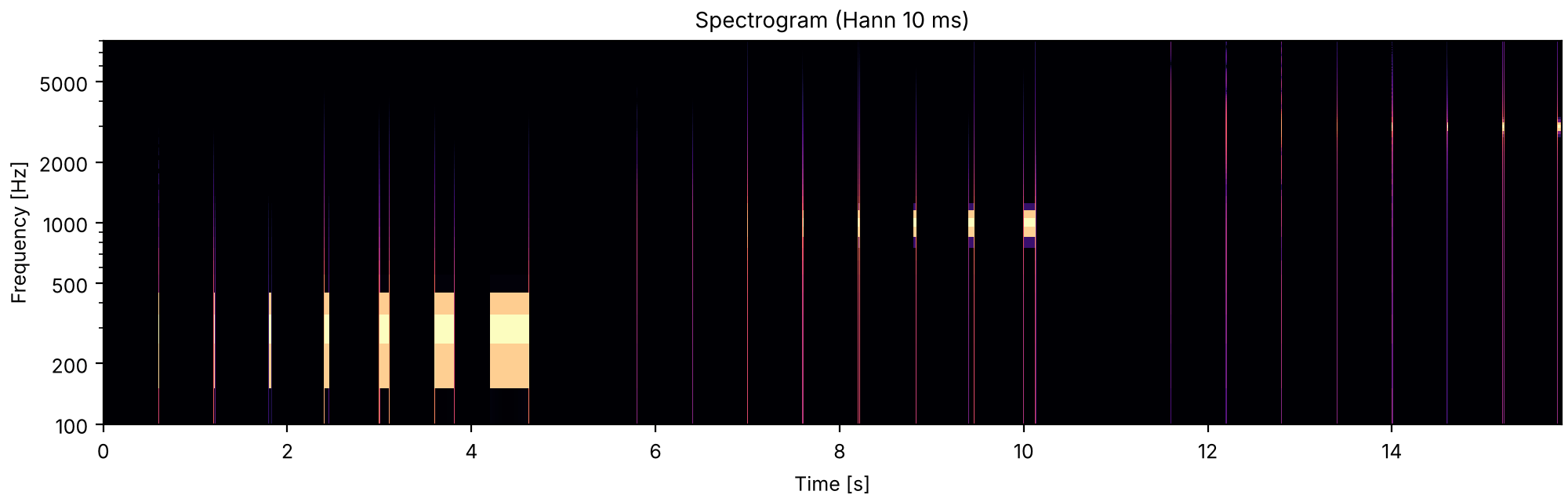
Listen for the moment a click turns into a tone. Each of the three series plays bursts of one tone lasting 1, 2, 4 and on up to 128 periods: first at 300 Hz, then 1000 Hz, then 3000 Hz. The booklet asks how many periods it takes to establish a sense of pitch, and describes the shortest bursts as clicks that take on a pitch as they lengthen.

Houtsma, Rossing & Wagenaars, Demonstration 13, after Doughty & Garner (1948). Bursts of 1, 2, 4, 8, 16, 32, 64 and 128 periods of 300, 1000 and 3000 Hz, as in the booklet, each starting and ending at a zero crossing of a sine with no ramps. Ours: the bursts start 0.6 s apart, with 1 s between the series, which are played once where the disc plays them twice.

pk1_tone_bursts_from_one_period_to_128.flac, 15.8 s, mono
Plots of the tone bursts from one period to 128 sound
Code
events, start = [], 0.0
for freq in (300, 1000, 3000):
    for k, periods in enumerate(2 ** np.arange(8)):
        burst = so.pure_tone(periods / freq, FS, freq, phase=-np.pi / 2)
        events.append((start + 0.6 * k, burst))
    start += 0.6 * 8 + 1.0
sound = finish(place(events))
fig, playhead = show(sound, fmin=100, fmax=8000, win=10e-3, title="Spectrogram (Hann 10 ms)")
Matching an octave

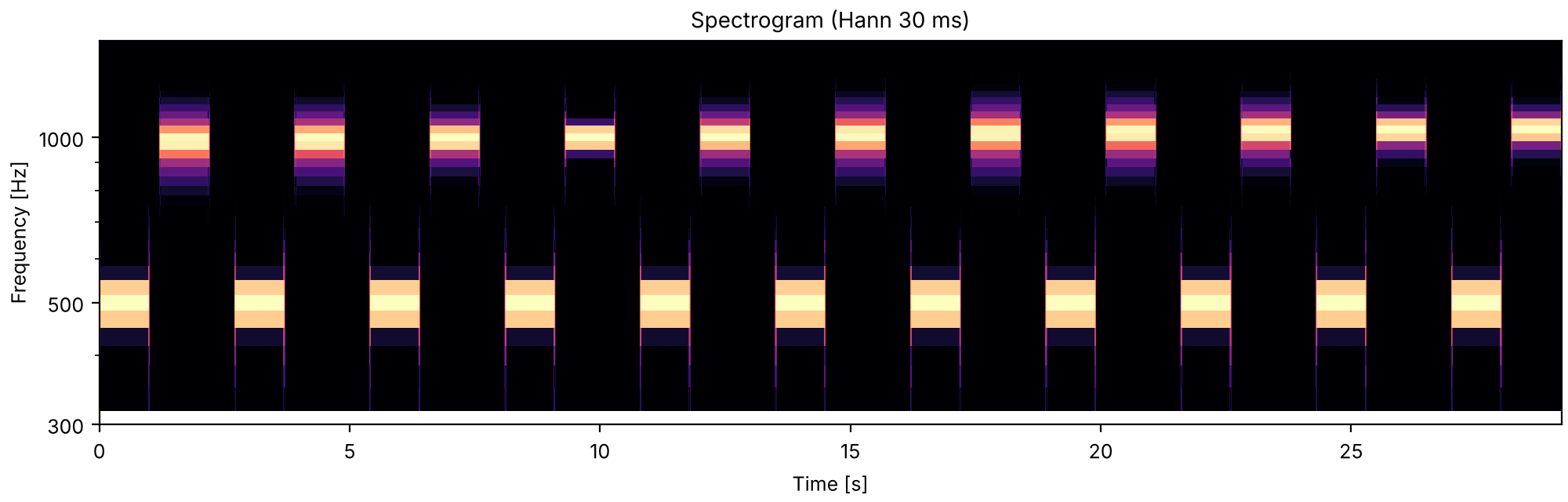
Listen for the pair that sounds like a true octave. A 500 Hz tone alternates with a second tone that steps up from 985 to 1035 Hz, 5 Hz at a time, so that the exact octave, 1000 Hz, is the fourth pair. The booklet expects most listeners to choose a tone somewhere around 1010 Hz, an octave a little wider than 2 to 1.

Houtsma, Rossing & Wagenaars, Demonstration 15, after Ward (1954). A 500 Hz tone of 1 s alternating with a 1 s tone from 985 to 1035 Hz in 5 Hz steps, as in the booklet. Ours: equal levels, 20 ms ramps, 0.2 s between the tones of a pair and 0.5 s between pairs, and one pass where the disc plays two.

pk2_matching_an_octave.flac, 29.2 s, mono

Plots of the matching an octave sound
Code
events = []
for k, upper in enumerate(np.arange(985, 1036, 5)):
    events += [(2.7 * k, tone(500, 1.0)), (2.7 * k + 1.2, tone(upper, 1.0))]
sound = finish(place(events))
fig, playhead = show(sound, fmin=300, fmax=1500)

Pitch without a fundamental

The pitch of a harmonic tone does not need its fundamental: hearing takes it from the spacing and pattern of the harmonics that remain.

Harmonics removed from the bottom

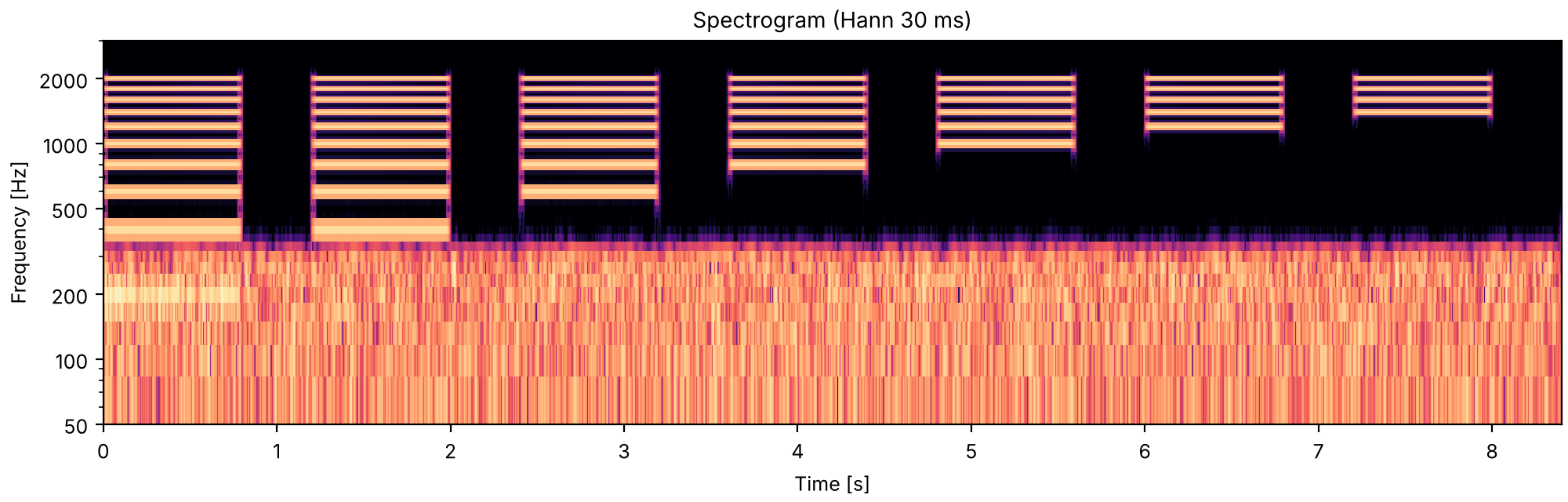
Listen for whether the pitch changes as the tone loses its lowest harmonics, one at a time. The timbre gets thinner and brighter at each step; the booklet asks whether the pitch changes too. A soft low rumble plays throughout.

Houtsma, Rossing & Wagenaars, Demonstration 20. Ten harmonics of 200 Hz at equal amplitude, first all ten, then without the fundamental, then without the lowest two, and so on, as in the booklet, which adds noise below 300 Hz at -10 dB to mask any 200 Hz difference tone that distortion in the playback might make. Ours: the steps go on until harmonics 7 to 10 are left; the tones are 0.8 s long, 1.2 s apart, in sine phase with 20 ms ramps; and the noise's -10 dB is taken relative to the full ten-harmonic tone.

pk3_harmonics_removed_from_the_bottom.flac, 8.4 s, mono

Plots of the harmonics removed from the bottom sound
Code
tones = [(1.2 * k, harmonics(200, np.arange(lowest, 11), 0.8)) for k, lowest in enumerate(range(1, 8))]
complete_rms_db = 10 * np.log10(10)  # ten harmonics, each at RMS 1
rumble = noise(8.4, (20, 300), complete_rms_db - 10, seed=20)
sound = finish(so.Sound(place(tones, dur=8.4).data[: rumble.n_samples] + rumble.data, FS))
fig, playhead = show(sound, fmin=50, fmax=3000)

Three partials shifted off the harmonic series

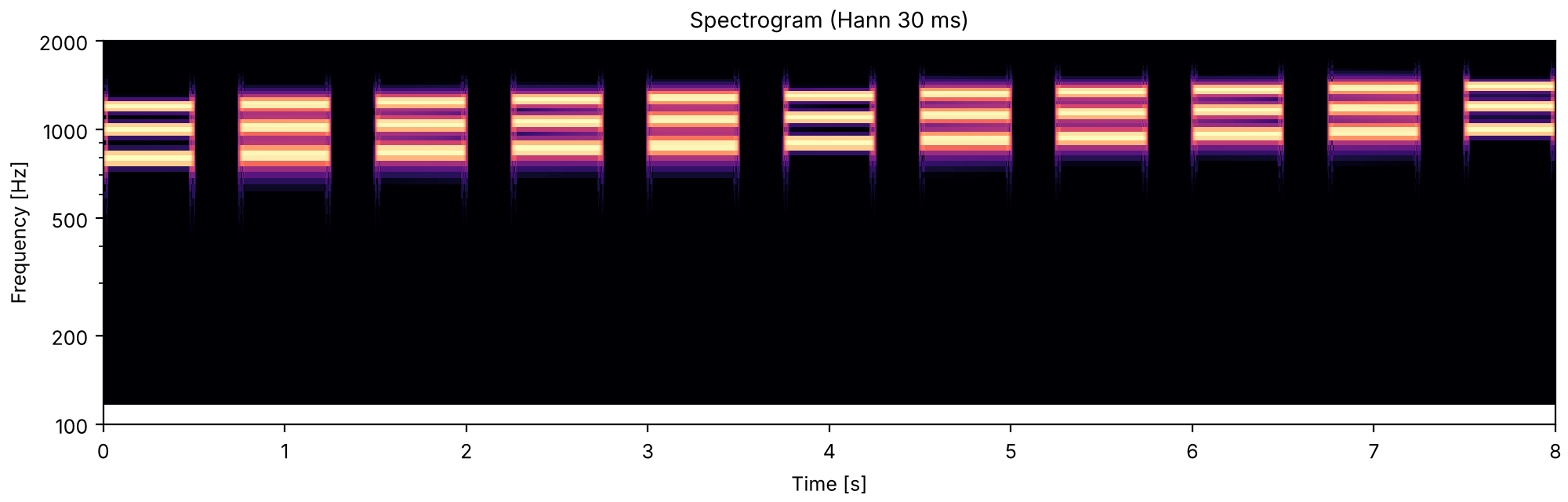
Listen for a low pitch that rises a little at each step. Three partials 200 Hz apart, 800, 1000 and 1200 Hz, all move up 20 Hz at a time until they are 1000, 1200 and 1400 Hz. Each partial rises by 200 Hz in all, yet the booklet expects the low pitch heard to rise only from 200 Hz to about 241 Hz, a nearly common factor of the three, and notes that a second or even third rising pitch may be heard as well. A difference tone made by distortion would stay at 200 Hz, the spacing.

Houtsma, Rossing & Wagenaars, Demonstration 21, after Schouten, Ritsma & Cardozo (1962). Three partials, equal in level, 0.5 s long, shifted up in ten 20 Hz steps, as in the booklet. Ours: 20 ms ramps, a pause of 0.25 s between tones, and one pass where the disc plays two.

pk4_three_partials_shifted_off_the_harmonic_series.flac, 8.0 s, mono

Plots of the three partials shifted off the harmonic series sound
Code
events = [(0.75 * k, partials(np.array([800, 1000, 1200]) + 20 * k, 0.5)) for k in range(11)]
sound = finish(place(events))
fig, playhead = show(sound, fmin=100, fmax=2000)

Matching the shifted pitch

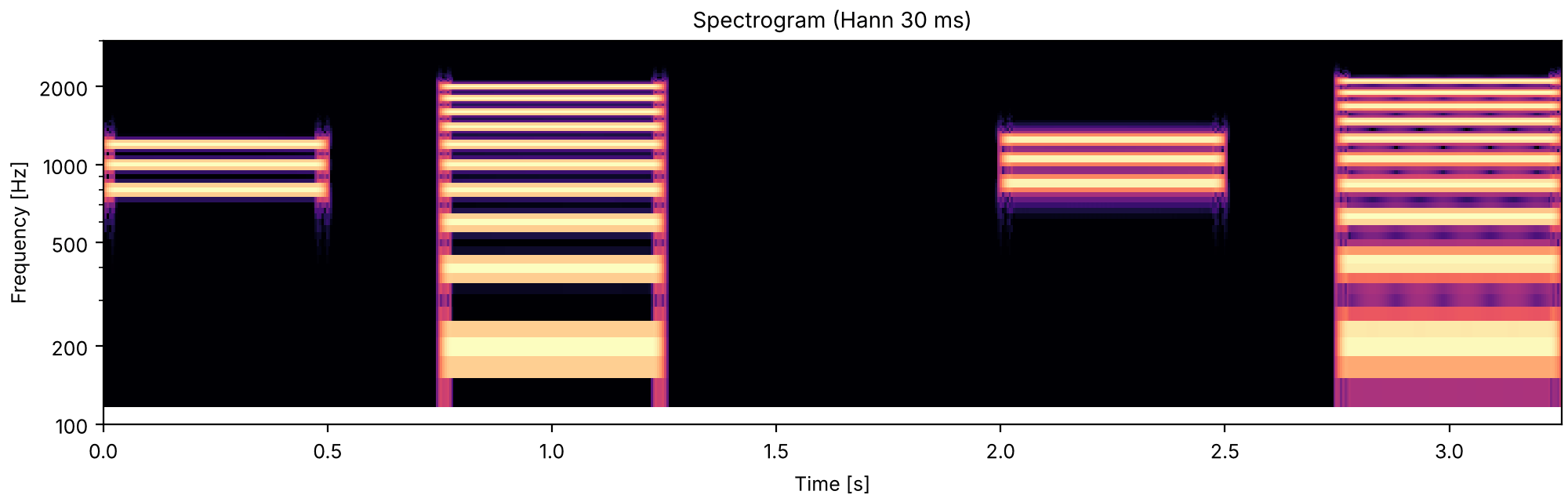
Listen for the pitch of each three-partial tone against the harmonic tone after it. First 800, 1000 and 1200 Hz, then a harmonic tone on 200 Hz; then 850, 1050 and 1250 Hz, then a harmonic tone on 210 Hz. The booklet reports the low pitches of the two three-partial tones well matched by the two harmonic tones, although the second set is not harmonic and its spacing is still 200 Hz.

Houtsma, Rossing & Wagenaars, Demonstration 21, its second part. The partials and fundamentals are the booklet's. Ours: the matching tones hold harmonics 1 to 10 at equal amplitude, every tone is 0.5 s long, and the pauses are 0.25 s within a pair and 0.75 s between pairs.

pk4b_matching_the_shifted_pitch.flac, 3.3 s, mono

Plots of the matching the shifted pitch sound
Code
pairs = [((800, 1000, 1200), 200), ((850, 1050, 1250), 210)]
events = []
for k, (freqs, f0) in enumerate(pairs):
    events += [(2.0 * k, partials(freqs, 0.5)), (2.0 * k + 0.75, harmonics(f0, np.arange(1, 11), 0.5))]
sound = finish(place(events))
fig, playhead = show(sound, fmin=100, fmax=3000)

Up or down

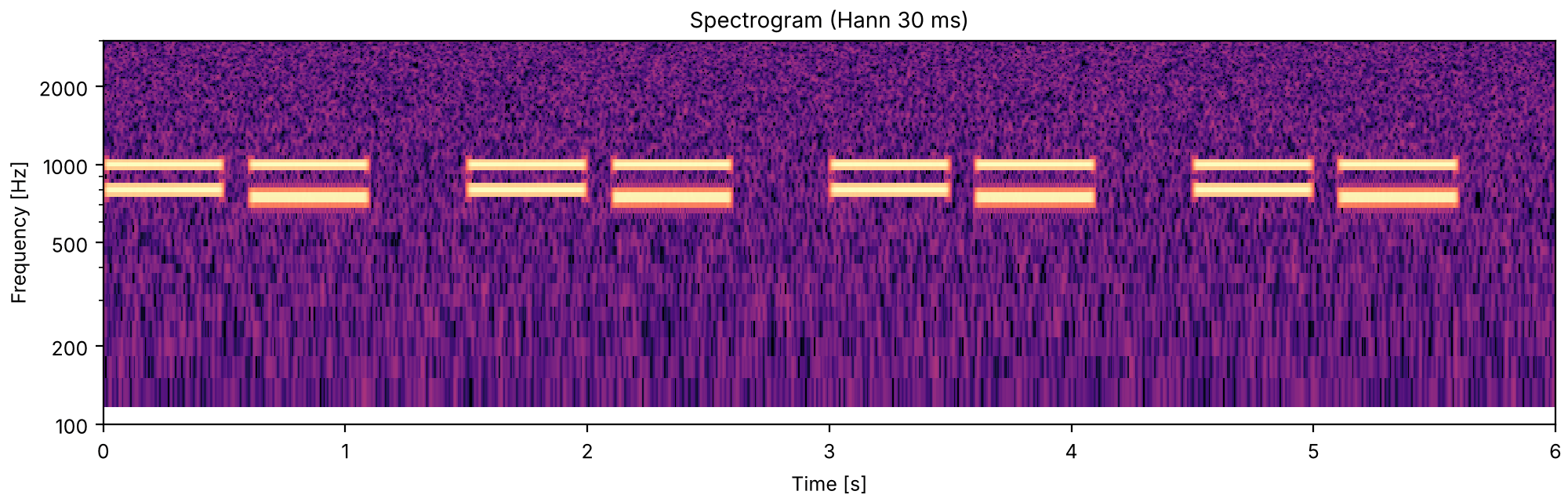
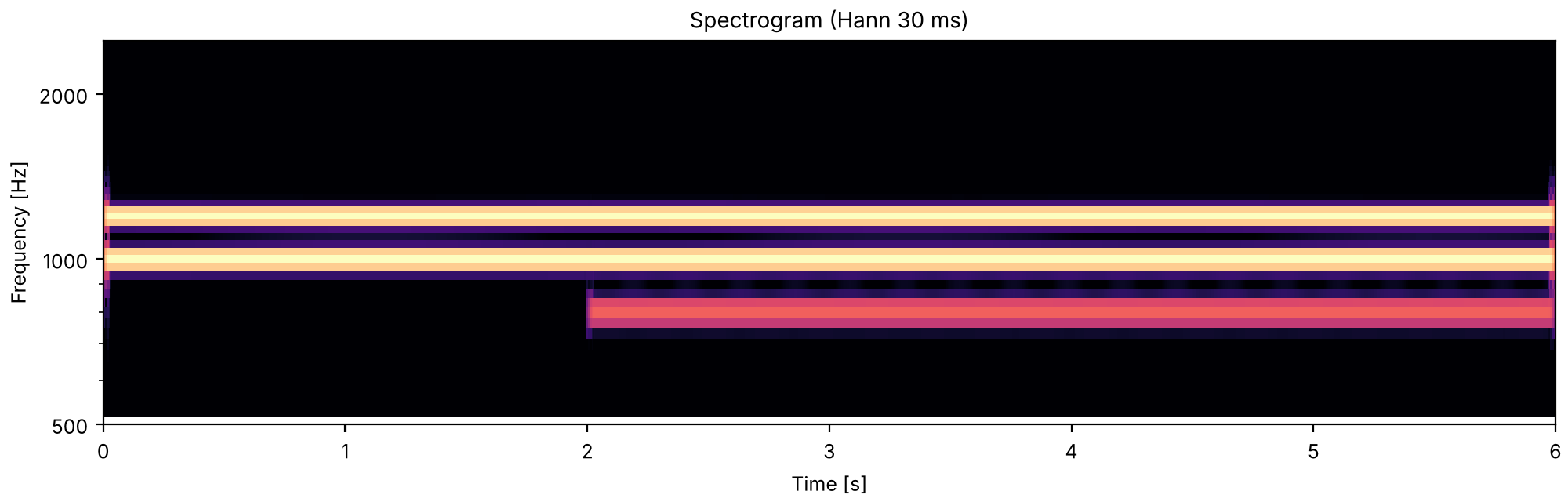
Listen for which way the pitch goes from the first tone of each pair to the second: up or down? In each pair, 800 and 1000 Hz are followed by 750 and 1000 Hz. The booklet explains that listening to the separate partials, you hear one go down, from 800 to 750 Hz, while listening to the whole, you hear the missing fundamental go up a major third, from 200 to 250 Hz. A soft noise plays behind them.

Houtsma, Rossing & Wagenaars, Demonstration 25, after Smoorenburg (1970). Two-tone complexes of 800 and 1000 Hz, then 750 and 1000 Hz, the pair played four times against a background of noise, as in the booklet. Ours: tones 0.5 s long with 20 ms ramps, 0.1 s apart, a pair every 1.5 s, and the noise, from 100 to 5000 Hz at 20 dB below one tone.

pk5_up_or_down.flac, 6.0 s, mono

Plots of the up or down sound
Code
events = []
for k in range(4):
    events += [(1.5 * k, partials((800, 1000), 0.5)), (1.5 * k + 0.6, partials((750, 1000), 0.5))]
pairs = place(events, dur=6.0)
hiss = noise(6.0, (100, 5000), -20, seed=25)
sound = finish(so.Sound(pairs.data[: hiss.n_samples] + hiss.data, FS))
fig, playhead = show(sound, fmin=100, fmax=3000)

Melodies of virtual pitch

A tune played with tones that have no energy at their own pitch still carries its melody. Noise that covers the frequencies of the pitches does not mask it; noise that covers the harmonics does.

A tune in pure tones and in high harmonics

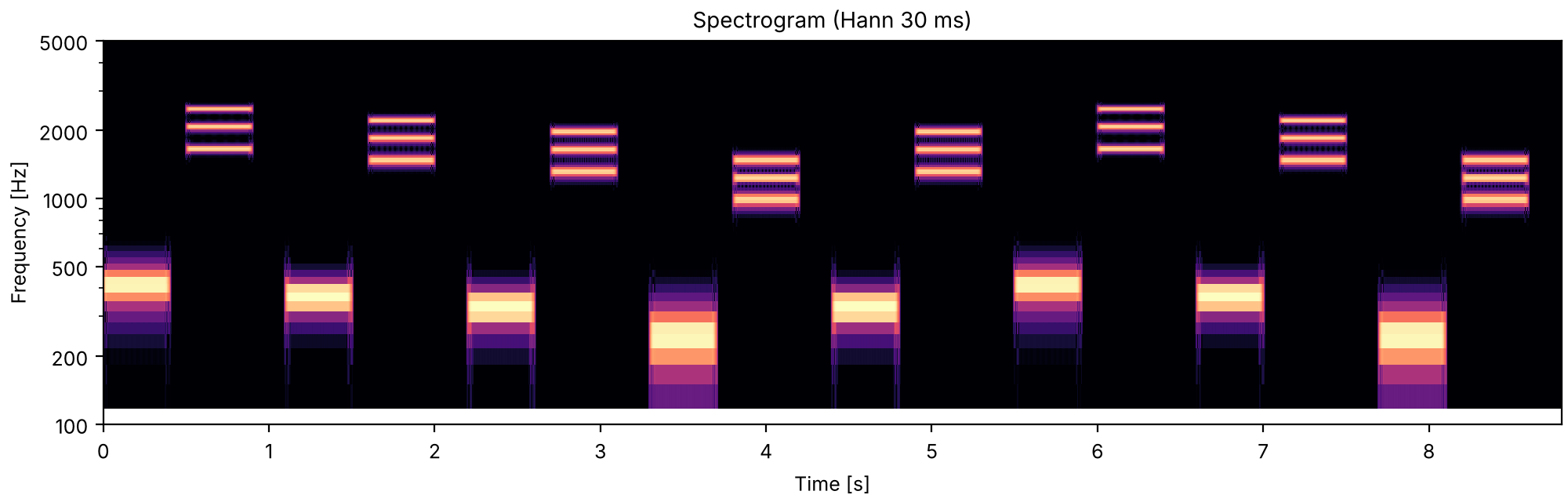
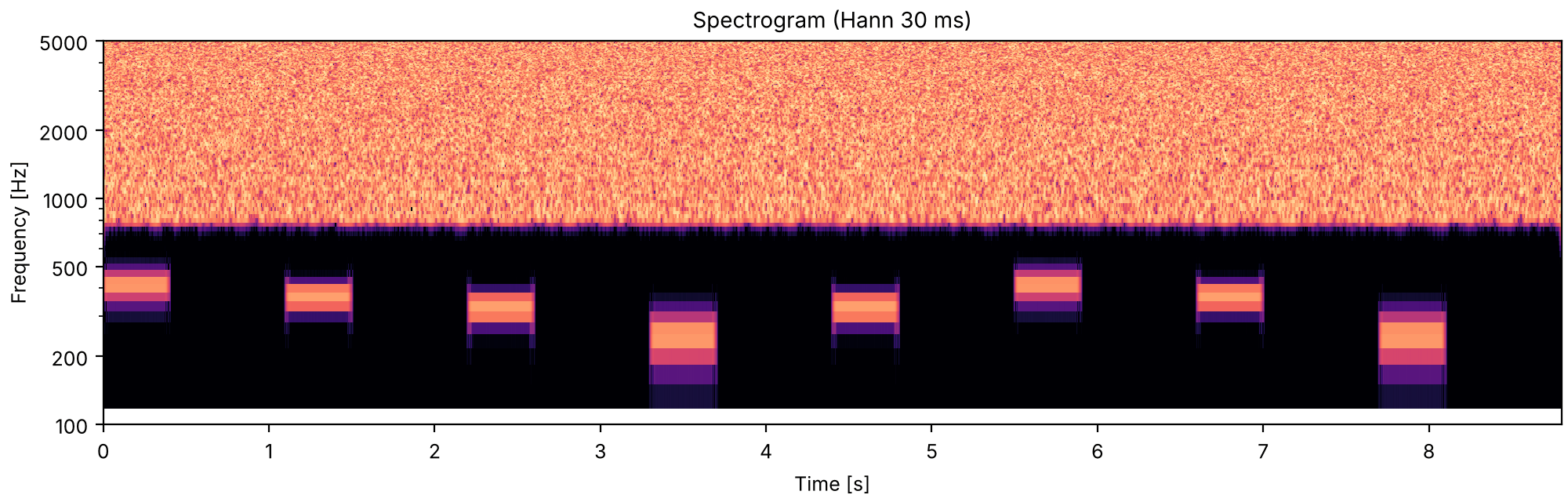
Listen for the tune of the Westminster chime twice over, in pairs: each note first as a pure tone, then as a tone of three high harmonics with the same pitch. The two versions carry the same melody, though the second has no energy at any of the notes' frequencies.

Houtsma, Rossing & Wagenaars, Demonstration 22. Each note is a pure tone, then a complex of its 4th, 5th and 6th harmonics, as in the booklet. The notes are ours: the first two changes of the Westminster Quarters, G#4 F#4 E4 B3 and E4 G#4 F#4 B3, in equal temperament (247 to 415 Hz), each tone 0.4 s long with 20 ms ramps, 0.1 s apart within a pair, a pair every 1.1 s. The complex tones have the same RMS as the pure tones.

pk6_a_tune_in_pure_tones_and_in_high_harmonics.flac, 8.8 s, mono

Plots of the a tune in pure tones and in high harmonics sound
Code
NOTES = {"B3": 246.94, "E4": 329.63, "F#4": 369.99, "G#4": 415.30}
TUNE = [NOTES[n] for n in ("G#4", "F#4", "E4", "B3", "E4", "G#4", "F#4", "B3")]


def westminster(masker=None):
    """Each note as a pure tone, then as harmonics 4 to 6 at the same total RMS; with `masker`
    noise added under the whole tune."""
    events = []
    for k, f0 in enumerate(TUNE):
        high = harmonics(f0, [4, 5, 6], 0.4) * np.sqrt(1 / 3)
        events += [(1.1 * k, tone(f0, 0.4)), (1.1 * k + 0.5, high)]
    tune = place(events, dur=1.1 * len(TUNE))
    if masker is not None:
        tune = so.Sound(tune.data[: masker.n_samples] + masker.data, FS)
    return tune


sound = finish(westminster())
fig, playhead = show(sound, fmin=100, fmax=5000)

The tune under low noise

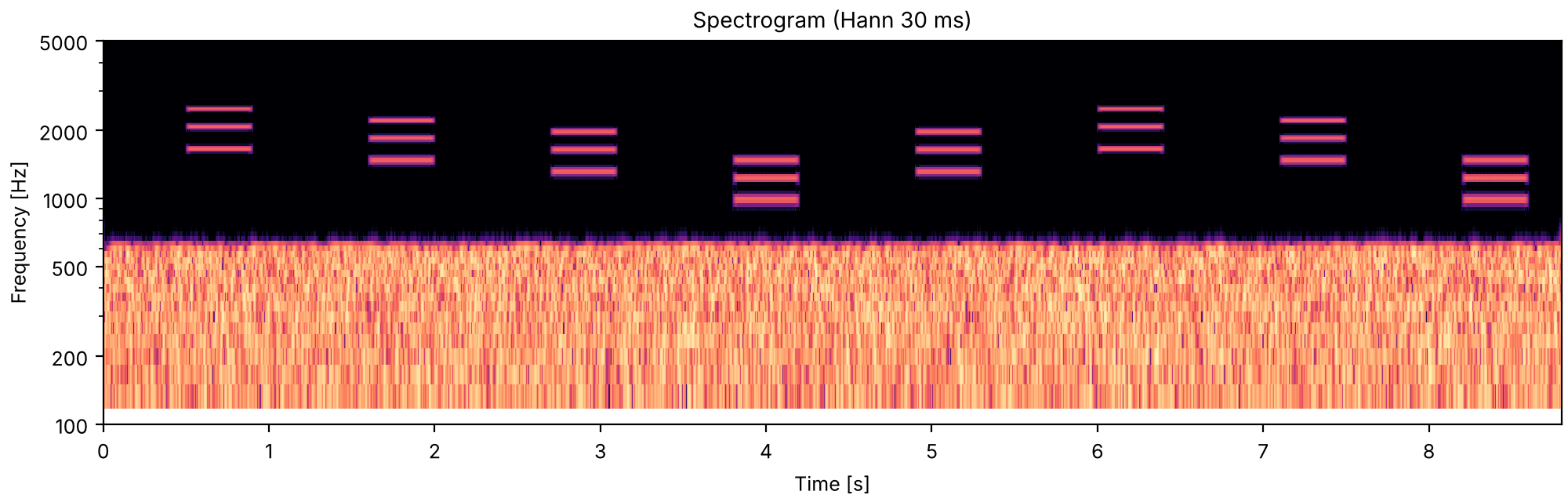
Listen for the same pairs under a low noise, which covers the pure tones. The booklet reports that the pitches of the complex tones are still heard, so the melody is still there, although the noise covers the frequencies where those pitches lie.

Houtsma, Rossing & Wagenaars, Demonstration 22, its second part: low-pass noise added. The booklet does not give the noise; here it runs from 20 to 600 Hz, below the lowest harmonic of the complex tones (988 Hz), at 15 dB above a pure tone's RMS, and is ours.

pk6b_the_tune_under_low_noise.flac, 8.8 s, mono

Plots of the the tune under low noise sound
Code
low_noise = noise(1.1 * len(TUNE), (20, 600), 15, seed=22)
sound = finish(westminster(low_noise))
fig, playhead = show(sound, fmin=100, fmax=5000)

The tune under high noise

Listen for the same pairs under a high noise, which covers the harmonics of the complex tones. The booklet reports that the pure-tone melody is still heard.

Houtsma, Rossing & Wagenaars, Demonstration 22, its third part: high-pass noise added. Ours: the noise runs from 800 to 5000 Hz, above the highest pure tone, at 20 dB above a pure tone's RMS.

pk6c_the_tune_under_high_noise.flac, 8.8 s, mono

Plots of the the tune under high noise sound
Code
high_noise = noise(1.1 * len(TUNE), (800, 5000), 20, seed=23)
sound = finish(westminster(high_noise))
fig, playhead = show(sound, fmin=100, fmax=5000)

The tune on random low harmonics

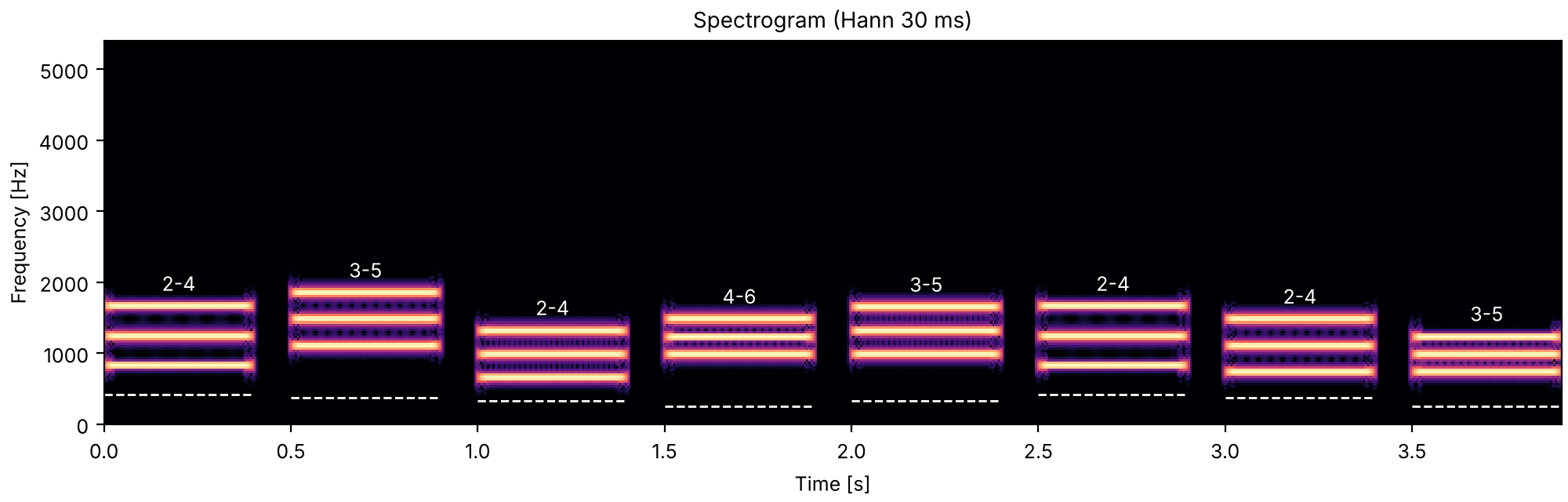
Listen for the same tune, now with each note made of three successive harmonics chosen at random from the second to the sixth. The timbre changes from note to note; the booklet reports that the melody stays clearly recognizable, which shows that it is not followed by tracking any one harmonic from note to note.

Houtsma, Rossing & Wagenaars, Demonstration 23, after Houtsma (1984). Three successive harmonics of each note, with harmonic numbers between 2 and 6, as in the booklet. Ours: the tune and timing (0.4 s notes, one every 0.5 s), the random draws (seed 231), equal amplitudes and 20 ms ramps.

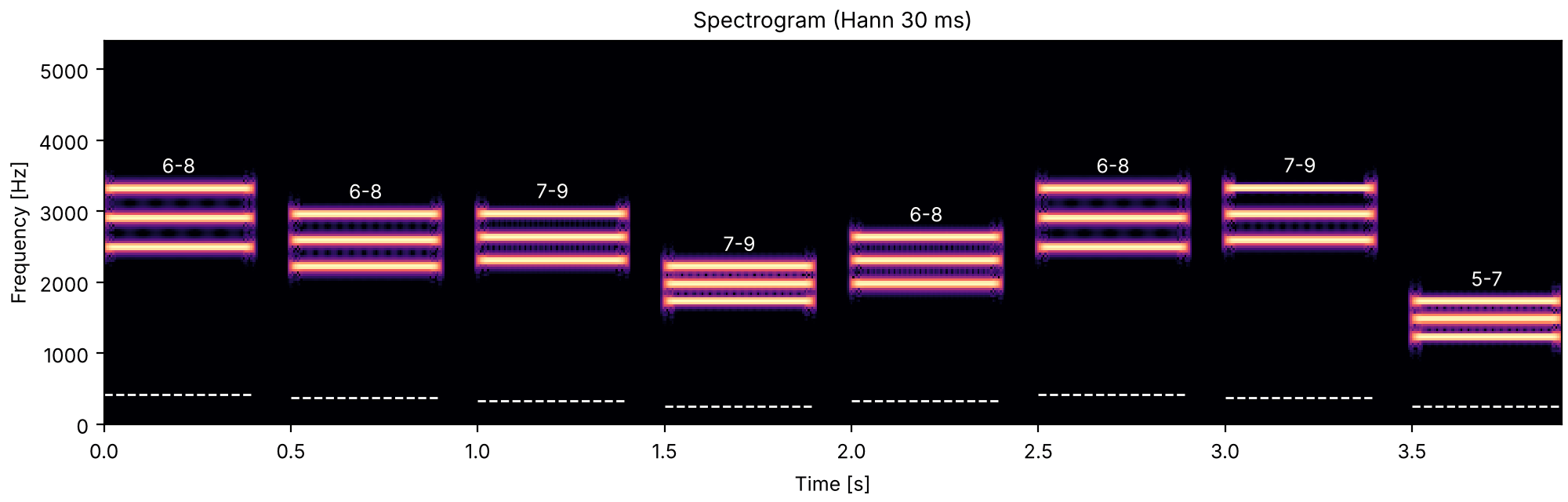
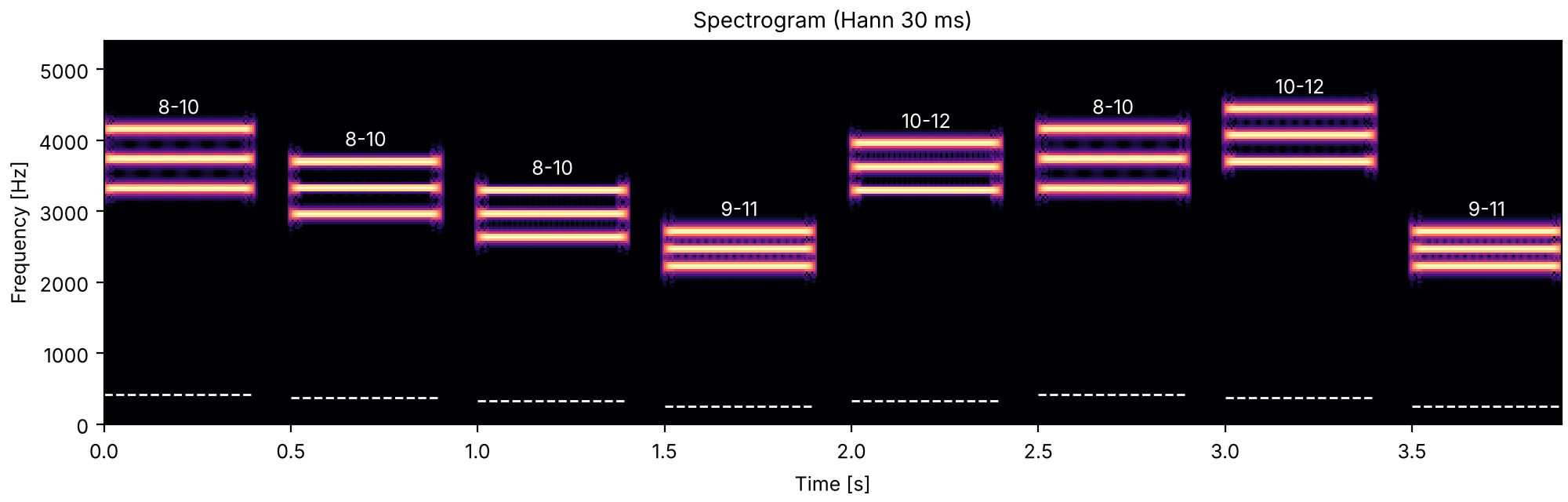
The three figures share one frequency axis. Above each note are its harmonic numbers, and the dashed line is its fundamental, which is not in the sound.

pk7_the_tune_on_random_low_harmonics.flac, 3.9 s, mono

Plots of the the tune on random low harmonics sound
Code
def random_harmonics(lowest, highest, seed):
    rng = np.random.default_rng(seed)
    events, firsts = [], []
    for k, f0 in enumerate(TUNE):
        first = rng.integers(lowest, highest - 1)  # three successive harmonics within the range
        events.append((0.5 * k, harmonics(f0, [first, first + 1, first + 2], 0.4)))
        firsts.append(first)
    return place(events), firsts


def show_harmonics(snd, firsts):
    """The spectrogram on a linear axis, the same for all three parts, with the harmonic numbers
    of each note written above it and its missing fundamental dashed."""
    fig, panels = show(snd, fmin=0, fmax=5400, log=False)
    for k, (f0, first) in enumerate(zip(TUNE, firsts, strict=True)):
        panels[0].plot([0.5 * k, 0.5 * k + 0.4], [f0, f0], color="white", linestyle="--", linewidth=1)
        panels[0].text(
            0.5 * k + 0.2,
            f0 * (first + 2) + 150,
            f"{first}-{first + 2}",
            color="white",
            ha="center",
            va="bottom",
            fontsize=9,
        )
    return fig, panels


sound, firsts = random_harmonics(2, 6, seed=231)
sound = finish(sound)
fig, playhead = show_harmonics(sound, firsts)

The tune on random middle harmonics

Listen for the tune again, with harmonics drawn from the fifth to the ninth.

Houtsma, Rossing & Wagenaars, Demonstration 23, its second part: harmonic numbers between 5 and 9. Ours as before (seed 232).

pk7b_the_tune_on_random_middle_harmonics.flac, 3.9 s, mono

Plots of the the tune on random middle harmonics sound
Code
sound, firsts = random_harmonics(5, 9, seed=232)
sound = finish(sound)
fig, playhead = show_harmonics(sound, firsts)

The tune on random high harmonics

Listen for the tune once more, with harmonics drawn from the eighth to the twelfth: the highest and most crowded together of the three.

Houtsma, Rossing & Wagenaars, Demonstration 23, its third part: harmonic numbers between 8 and 12. Ours as before (seed 233).

pk7c_the_tune_on_random_high_harmonics.flac, 3.9 s, mono

Plots of the the tune on random high harmonics sound
Code
sound, firsts = random_harmonics(8, 12, seed=233)
sound = finish(sound)
fig, playhead = show_harmonics(sound, firsts)

Pitch from a repetition

A sound added to a copy of itself delayed by a few milliseconds has a pitch at one over the delay, whatever the sound. The booklet traces this to Huygens, who heard a pitch in the sound of a fountain reflected from the steps of a staircase.

A scale of click pairs

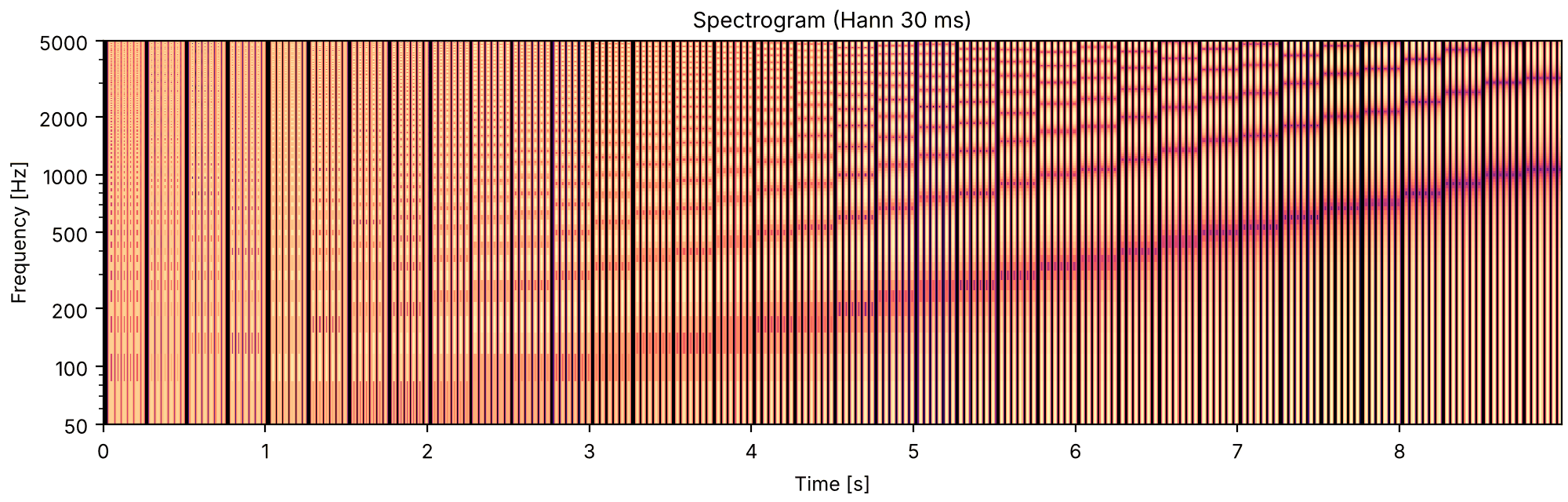
Listen for a scale rising five octaves, played by pairs of clicks. Within each pair the second click repeats the first after a delay, and the delay shrinks from note to note; the booklet gives the pitch heard as one over the delay.

Houtsma, Rossing & Wagenaars, Demonstration 26, its first part. A diatonic scale of five octaves played with pairs of identical pulses whose delay goes from 15 ms (a pitch of 67 Hz) down. The booklet gives the last delay as 0.48 ms; this scale, in equal temperament, ends at 15/32 = 0.47 ms. Ours: the scale's tuning; the pairs repeat regularly, 25 a second, which is too slow to give a pitch of its own; each note lasts 0.25 s; and the clicks are band-limited, so that delays between samples are exact.

pk8_a_scale_of_click_pairs.flac, 9.0 s, mono

Plots of the a scale of click pairs sound
Code
STEPS = np.array([0, 2, 4, 5, 7, 9, 11])  # the major scale, in semitones
NOTE = 0.25


def scale_delays(octaves, longest=15e-3):
    semitones = np.concatenate([STEPS + 12 * k for k in range(octaves)] + [[12 * octaves]])
    return longest / 2 ** (semitones / 12)


def click_pair(delay, half_width=64):
    """Two band-limited clicks `delay` seconds apart: windowed sincs, so the delay need not be a
    whole number of samples."""
    n = np.arange(-half_width, round(delay * FS) + half_width + 1)

    def windowed_sinc(x):
        return np.sinc(x) * np.where(np.abs(x) <= half_width, np.cos(np.pi * x / (2 * half_width)) ** 2, 0)

    return so.Sound(windowed_sinc(n) + windowed_sinc(n - delay * FS), FS)


def click_scale(delays, intervals, seed):
    rng = np.random.default_rng(seed)
    notes = []
    for delay in delays:
        notes.append(so.event_train(click_pair(delay), NOTE, intervals, rng=rng))
    return so.concat(notes)


sound = finish(click_scale(scale_delays(5), 1 / 25, seed=261))
fig, playhead = show(sound, fmin=50, fmax=5000)

A scale of click pairs at random times

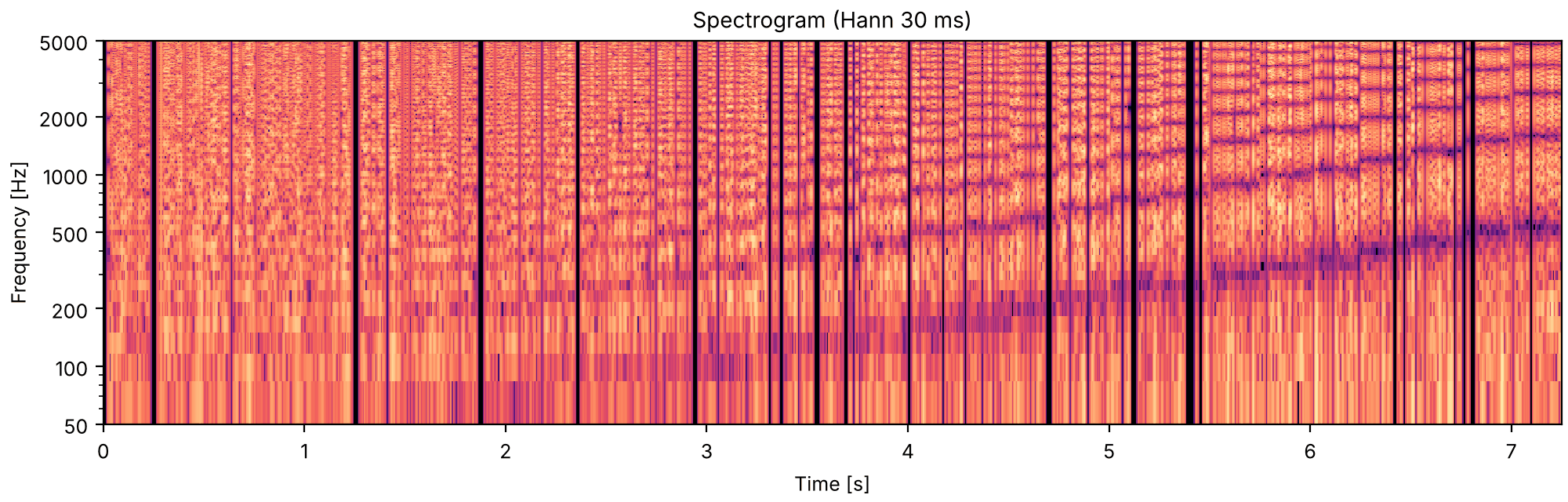
Listen for a scale rising four octaves, from click pairs that now come at random times. The booklet reports that the pitch at one over the delay is heard as before, though the pairs no longer come regularly.

Houtsma, Rossing & Wagenaars, Demonstration 26, its second part. A diatonic scale of four octaves; the pairs start at the times of a Poisson process, and the delay goes from 15 ms to 15/16 = 0.94 ms (the booklet gives 0.95 ms). Ours: 100 pairs a second on average, each note 0.25 s.

pk8b_a_scale_of_click_pairs_at_random_times.flac, 7.2 s, mono

Plots of the a scale of click pairs at random times sound
Code
import scipy.stats

sound = finish(click_scale(scale_delays(4), scipy.stats.expon(scale=1 / 100), seed=262))
fig, playhead = show(sound, fmin=50, fmax=5000)

A scale of echoed noise

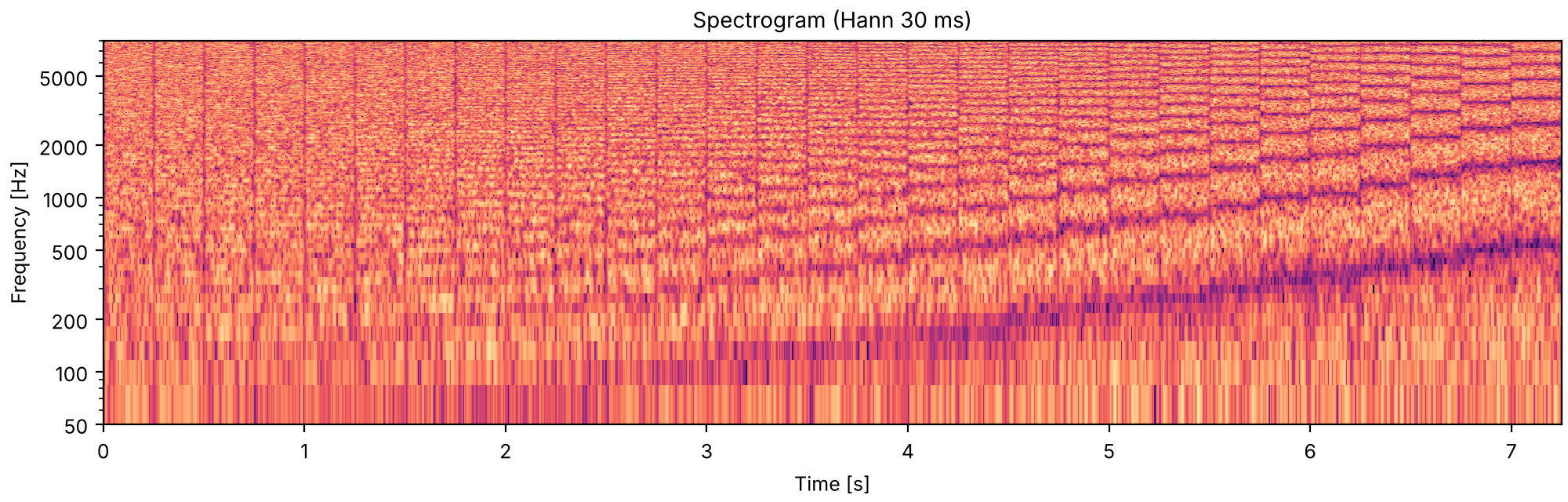
Listen for the same four-octave scale played by bursts of hiss, each added to a copy of itself delayed by the same amounts.

Houtsma, Rossing & Wagenaars, Demonstration 26, its third part: bursts of white noise echoed 15 ms to 0.94 ms later. Ours: 0.25 s bursts with 10 ms ramps, and the delay made exact by a phase shift in the frequency domain.

pk8c_a_scale_of_echoed_noise.flac, 7.2 s, mono

Plots of the a scale of echoed noise sound
Code
def echoed_noise(delay, rng):
    burst = so.gaussian_noise(NOTE, FS, rng=rng).data[:, 0]
    n = len(burst) + round(0.02 * FS)  # room for the echo
    spectrum = np.fft.rfft(burst, n)
    freqs = np.fft.rfftfreq(n, 1 / FS)
    echo = np.fft.irfft(spectrum * np.exp(-2j * np.pi * freqs * delay), n)
    both = np.pad(burst, (0, n - len(burst))) + echo
    return ramped(so.Sound(both[: len(burst)], FS), 10e-3)


rng = np.random.default_rng(263)
sound = finish(so.concat([echoed_noise(delay, rng) for delay in scale_delays(4)]))
fig, playhead = show(sound, fmin=50, fmax=8000)

Beats and combination tones

Two tones heard together can make beats, both when their frequencies are close and when they are close to a simple ratio; and the ear itself adds tones that are not in the sound.

Primary beats

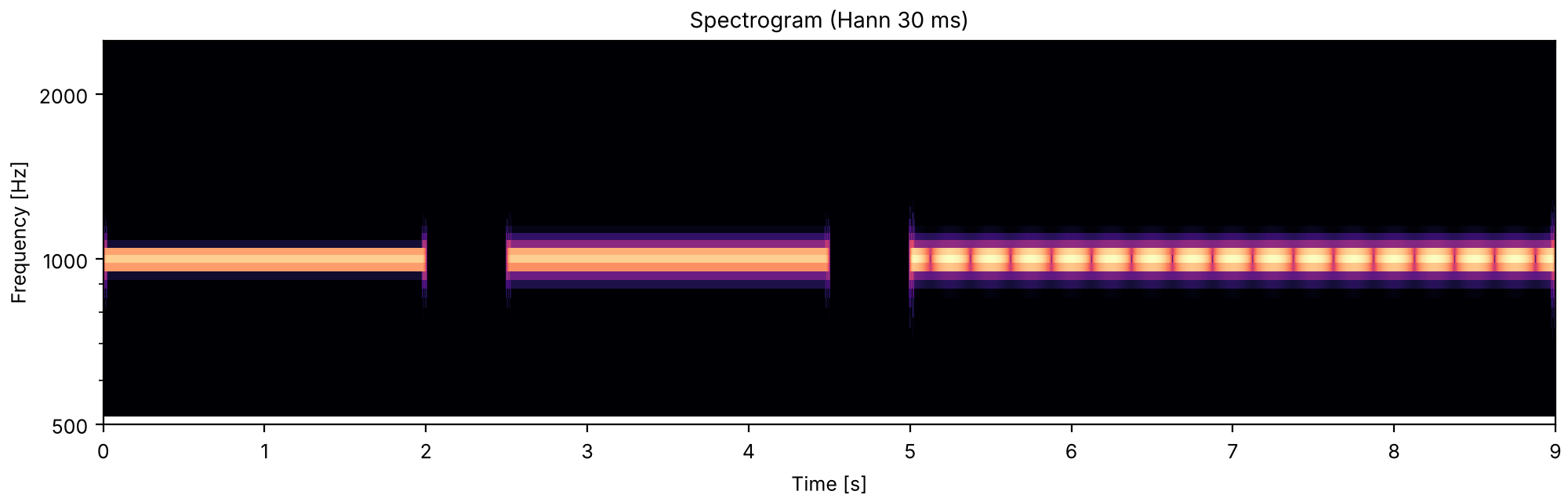
Listen for a steady tone, a second steady tone, then the two together, rising and falling in loudness four times a second: beats.

Houtsma, Rossing & Wagenaars, Demonstration 32, its first part. Pure tones of 1000 and 1004 Hz, first separately and then together, as in the booklet, which gives beats at 4 Hz. Ours: equal levels, 2 s each alone and 4 s together, 20 ms ramps and pauses of 0.5 s; one pass where the disc plays two.

pk9_primary_beats.flac, 9.0 s, mono

Plots of the primary beats sound
Code
pause = so.silence(0.5, FS)
sound = finish(so.concat([tone(1000, 2.0), pause, tone(1004, 2.0), pause, partials((1000, 1004), 4.0)]))
fig, playhead = show(sound, fmin=500, fmax=2500)

Beats of mistuned consonances

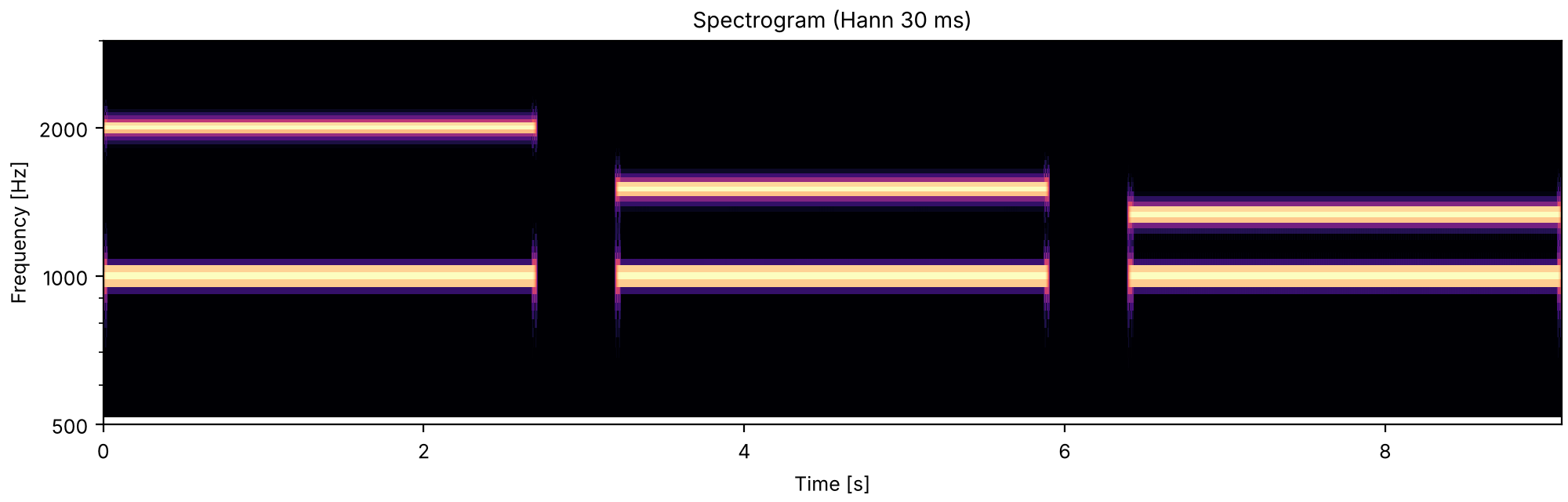
Listen for beats again, four a second, in three pairs of tones that are far apart: a little more than an octave, a fifth and a fourth. The booklet invites you to compare how strong the beats are with those of the first part, where the two tones were 4 Hz apart.

Houtsma, Rossing & Wagenaars, Demonstration 32, its second part. A 1000 Hz tone with 2004, 1502 and 1334.67 Hz in turn, each mistuned from 2/1, 3/2 and 4/3 so that the second-order beats come 4 times a second, as in the booklet. Ours: equal levels, 2.7 s each, 20 ms ramps, pauses of 0.5 s.

pk9b_beats_of_mistuned_consonances.flac, 9.1 s, mono

Plots of the beats of mistuned consonances sound
Code
mistuned = [partials((1000, f), 2.7) for f in (2004, 1502, 1334.67)]
sound = finish(so.concat([mistuned[0], pause, mistuned[1], pause, mistuned[2]]))
fig, playhead = show(sound, fmin=500, fmax=3000)

A probe beating with a tone that is not there

Listen for a third, softer tone joining two steady ones, and beating slowly, four times a second. The two tones are 1000 and 1200 Hz; the third is 804 Hz. Nothing in the sound is at 800 Hz, but the booklet reports a combination tone made in the ear at 2 x 1000 - 1200 = 800 Hz, which the 804 Hz probe beats with. Combination tones are louder at higher levels; the booklet notes that at about 80 dB they are heard over a wide range.

Houtsma, Rossing & Wagenaars, Demonstration 34, after Goldstein (1967). Tones of 1000 and 1200 Hz, then an 804 Hz probe added, as in the booklet. Its text calls 800 Hz the quadratic difference tone; it is the cubic one, 2f1 - f2 (the quadratic one, f2 - f1, is at 200 Hz). Ours: equal levels for the two tones, the probe 20 dB below them, 2 s of the two tones before the probe joins for 4 s, and 20 ms ramps.

pk10_a_probe_beating_with_a_tone_that_is_not_there.flac, 6.0 s, mono

Plots of the a probe beating with a tone that is not there sound
Code
two = partials((1000, 1200), 6.0)
probe = place([(2.0, tone(804, 4.0).gain_db(-20))], dur=6.0)
sound = finish(so.Sound(two.data + probe.data[: two.n_samples], FS))
fig, playhead = show(sound, fmin=500, fmax=2500)

Combination tones moving

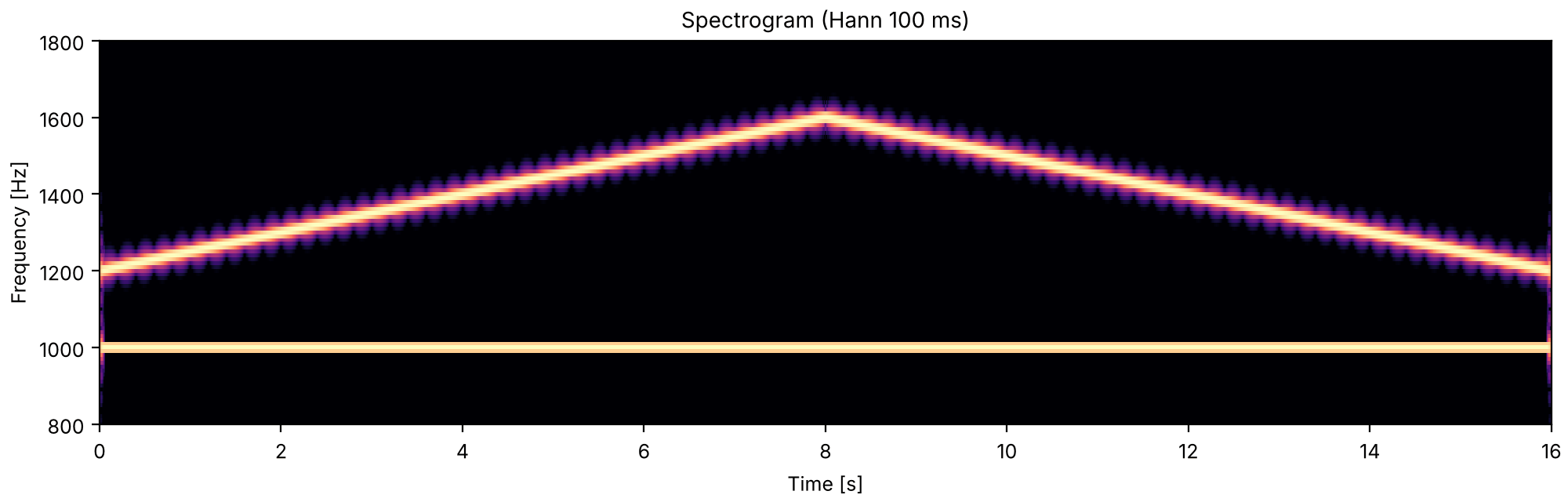
Listen for a low tone moving down while the upper of the two tones rises, from 1200 to 1600 Hz and back. The booklet describes the cubic difference tone, 2f1 - f2, moving opposite to the upper tone, soon joined by the quadratic one, f2 - f1, which rises with it; the two should cross when the upper tone is at 1500 Hz, where both are at 500 Hz. Neither is in the sound.

Houtsma, Rossing & Wagenaars, Demonstration 34, its second part. A steady 1000 Hz tone with a second tone gliding from 1200 to 1600 Hz and back, as in the booklet, which says only that it moves slowly. Ours: 8 s up and 8 s down in a straight line, equal levels, 20 ms ramps.

pk10b_combination_tones_moving.flac, 16.0 s, mono

Plots of the combination tones moving sound
Code
times = np.array([0.0, 8.0, 16.0])
glide = so.harmonic_complex(16.0, FS, (times, np.array([1200, 1600, 1200])), harmonics=[1], ramp=0)
steady = so.pure_tone(16.0, FS, 1000)
sound = finish(ramped(so.Sound(steady.data[:, 0] + glide.data[:, 0], FS)))
fig, playhead = show(sound, fmin=800, fmax=1800, log=False, win=0.1, title="Spectrogram (Hann 100 ms)")

References

  • Houtsma, Rossing & Wagenaars (1987). Auditory Demonstrations (compact disc and booklet). Institute for Perception Research (IPO), Eindhoven, and the Acoustical Society of America. Booklet.
  • Doughty & Garner (1948). Pitch characteristics of short tones. II. Pitch as a function of tonal duration. J. Exp. Psychol. 38(4), 478–494. doi:10.1037/h0057850.
  • Goldstein (1967). Auditory nonlinearity. JASA 41(3), 676–699. doi:10.1121/1.1910396.
  • Houtsma (1984). Pitch salience of various complex sounds. Music Perception 1(3), 296–307. doi:10.2307/40285262.
  • Schouten, Ritsma & Cardozo (1962). Pitch of the residue. JASA 34(9B), 1418–1424. doi:10.1121/1.1918360.
  • Smoorenburg (1970). Pitch perception of two-frequency stimuli. JASA 48(4B), 924–942. doi:10.1121/1.1912232.
  • Ward (1954). Subjective musical pitch. JASA 26(3), 369–380. doi:10.1121/1.1907344.

The papers were checked for their publication details only; the parameters on this page come from the booklet, and those marked as ours are choices made for this page.